


Patrick Banks Law drafts last wills and testaments for individuals and families throughout Bergen County, New Jersey. Attorney Patrick Banks prepares wills that meet New Jersey’s specific execution requirements, name the right executor and guardian, and hold up if a family member later questions them. A will is often the first document families complete, and a free initial call is the place to start.
A will sounds simple. Sign a document, name who gets what, done.
In practice, a will that skips New Jersey’s execution requirements, uses vague language, or fails to name a backup executor can create exactly the confusion it was meant to prevent.
Attorney Banks has drafted wills for Bergen County families since 2007, and has also litigated will contests in Surrogate’s Court, which means he drafts with an eye toward what actually holds up under scrutiny.
That perspective shapes small decisions that matter later, such as which witnesses to use, how to phrase a disinheritance clearly enough to withstand a challenge, and when a simple will is genuinely sufficient versus when it should be paired with additional planning.

What a Will Actually Does
A last will and testament names an executor to manage your estate after you pass away.
It directs how your property is distributed among the beneficiaries you choose, in the shares or specific gifts you specify.
For parents of minor children, it nominates a guardian to raise them if both parents are gone. It can also create a simple testamentary trust, one that comes into existence only through the will itself, to hold a young beneficiary’s inheritance until an age you choose.
A will cannot control everything you own. Life insurance, retirement accounts, and jointly held property generally pass according to their own beneficiary designations or ownership terms, regardless of what your will says.
Requirements for a Valid Will in New Jersey
New Jersey requires specific formalities for a will to be valid, and skipping any of them can open the door to a later challenge.
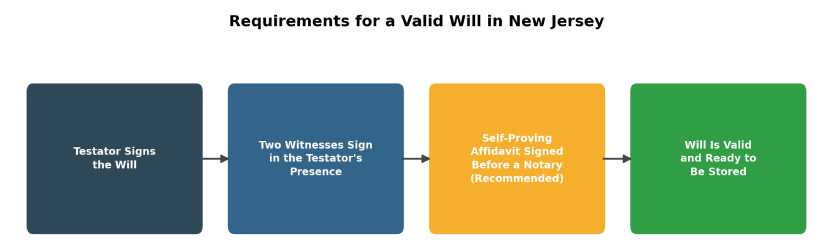
Standard execution steps for a typed will in New Jersey.
You must be at least 18 years old and of sound mind, meaning you understand generally what you own, who your natural heirs are, and that you are signing a document that directs how your property will be distributed.
The will must be signed by you and by two witnesses, each at least 18 and mentally competent, who sign in your presence.
A witness who is also a beneficiary does not automatically invalidate the will, but it can void that specific witness’s own inheritance under the will. Using disinterested witnesses, meaning people who inherit nothing under the document, avoids this problem entirely.
New Jersey does not require a will to be notarized to be valid, but skipping the self-proving affidavit means your executor may need to find a witness willing to testify to the will’s authenticity when it is time to probate, which can be difficult after many years have passed.
A self-proving affidavit, signed by you and the witnesses before a notary, is not required but is strongly recommended. It allows the will to be admitted to probate without tracking down witnesses to testify, which can matter years after signing when a witness has moved away or passed away.
Handwritten Wills in New Jersey
New Jersey recognizes holographic, meaning handwritten, wills under specific conditions. The signature and the material provisions disposing of property must be entirely in your own handwriting, and no witnesses are required.
A holographic will can be valid in an emergency, but it is far more likely to be challenged during probate than a properly witnessed, typed will. Relying on one as a primary estate plan is generally not advisable when there is time to do otherwise.
Courts scrutinize handwritten wills closely, particularly when a pre-printed form was used and filled in by hand, since only the truly handwritten portions count toward validity and the rest is disregarded entirely when a judge decides whether the document qualifies.
Choosing Your Executor and Guardian
Your will is where you formally name your executor, the person responsible for managing your estate through the Bergen County Surrogate’s Court.
Naming at least one successor executor in the will itself matters, since a plan that only names one person leaves a gap if that person cannot serve when the time comes.
For parents of minor children, the guardian nomination in your will is often the single most consequential decision in the document. Without it, a court decides who raises your children with no input from you at all.
You can nominate different people for physical guardianship of your children and financial guardianship of their inheritance, which some families prefer when the best caregiver is not necessarily the best money manager.
New Jersey courts generally respect a parent’s nomination unless there is a specific reason not to, which makes this one of the few areas of estate planning where your written wishes carry substantial, direct weight even though a judge technically makes the final appointment.
Storing and Protecting Your Original Will
New Jersey generally requires the original signed will, not a copy, for probate purposes, which makes safe storage more important than many people realize.
A fireproof safe at home, a bank safe deposit box, or safekeeping with the attorney who drafted the will are all common options. Whichever you choose, tell your executor where to find it, since a will no one can locate functions the same as having no will at all.
Some Bergen County families file their will for safekeeping directly with the Surrogate’s Court during their lifetime, for a modest fee, which guarantees the original is preserved and easily located when needed.
Whatever storage method you choose, review it periodically, particularly after a move, to make sure the location is still secure and still known to the people who will need to find it.
Specific Gifts and the Residuary Clause
A well drafted will typically separates specific gifts from the residuary estate.
A specific gift names a particular item or amount going to a particular person, such as a piece of jewelry to a niece or a fixed sum to a friend.
The residuary clause then directs everything left over, after specific gifts, debts, and taxes, to your primary beneficiaries. Nearly every estate planning mistake involving an incomplete will traces back to a missing or poorly drafted residuary clause that leaves some asset with no stated recipient.
A residuary clause should also account for the possibility that a named beneficiary predeceases you. Naming an alternate, or specifying that a deceased beneficiary’s share passes to their own children, prevents a gap that would otherwise need to be resolved through New Jersey’s intestacy rules for just that portion of your estate.
Updating or Revoking a Will
A will can be changed at any time while you have capacity, through either a codicil or a completely new will.
A codicil is a short, separately signed and witnessed document that amends specific provisions of an existing will without replacing the whole thing. It works well for a small change, such as updating an executor, but multiple codicils layered over time can create confusion about which provisions actually control.
A completely new will, which typically includes language expressly revoking all prior wills, is usually the cleaner option after a major life event such as a marriage, divorce, or the birth of a child.
New Jersey law automatically revokes certain provisions in favor of a former spouse after a divorce, treating that spouse as if they had predeceased you for purposes of the will. Relying on this automatic rule instead of updating the document yourself is risky, since it does not address every provision that might reference your former spouse, such as a nomination as executor or guardian.
You can also revoke a will by physically destroying it with the intent to revoke it, but relying on this method alone, without a replacement plan, leaves you without a will in the meantime.


A Will Does Not Avoid Probate
A common misunderstanding is that having a will means avoiding the New Jersey probate process. It does not.
Any property titled solely in your name still passes through the Bergen County Surrogate’s Court, where your will is filed and becomes a public record before your executor can act on your estate’s behalf.
Families who want to avoid probate for privacy or efficiency reasons generally pair a will with a revocable living trust, using what is called a pour-over will to catch any asset accidentally left outside the trust.
Even a family that primarily uses a trust still needs a will for this reason. The pour-over will acts as a safety net, ensuring nothing accidentally left titled in your own name falls outside your intended plan.
What Happens Without a Will
Dying without a will in New Jersey means dying intestate, which puts the state’s default statute in charge of decisions you could otherwise have made yourself.
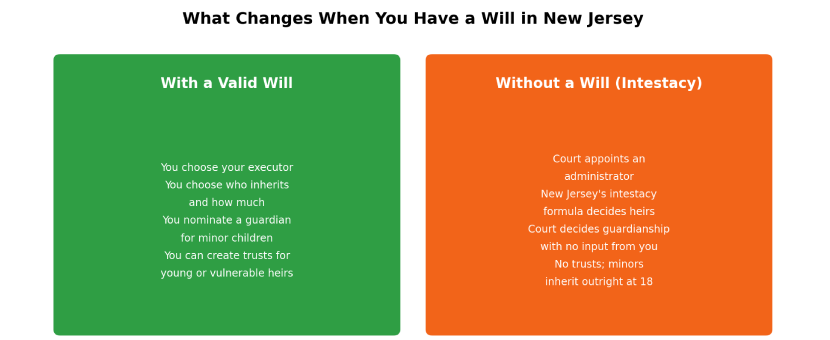
A general comparison. Specific outcomes depend on your individual family and asset situation.
The court appoints an administrator, generally a close family member, rather than the executor you would have chosen. New Jersey’s intestacy formula decides who inherits and in what shares, which may not match what you would have wanted, particularly in a blended family. Perhaps most significantly for parents of young children, a court decides guardianship with no guidance from you at all.
Minor beneficiaries under intestacy also inherit outright once they turn eighteen, with no trust structure to manage the money responsibly in the years before that, which a will can address directly through a simple testamentary trust.
If You Are Concerned About an Existing Will’s Validity
Sometimes the question is not how to draft a will, but whether an existing will is valid.
Concerns about improper execution, a signature that does not look genuine, or a document signed shortly before death under suspicious circumstances raise different legal questions than drafting a new will, and generally call for a conversation about your options for challenging it.
New Jersey imposes strict deadlines for challenging a will after it has been admitted to probate, so you should raise concerns like this promptly rather than waiting.
Frequently Asked Questions
Common Concerns About Getting a Will Drafted
“I do not have enough assets to need a real will.”
Naming a guardian for minor children and choosing your own executor are reasons enough to have a will, regardless of your estate’s size.
“I can just use an online template.”
A generic template can’t account for New Jersey’s specific witnessing requirements or your family situation, and a document that fails those requirements can be challenged even when your intentions were clear.
“My situation is simple, so this should not take long.”
Simple estates often do involve a straightforward will, but confirming that your situation is actually simple, rather than assuming it, is worth a short conversation before you sign anything.
What Happens When You Call
Reaching out starts with a free initial phone call or meeting.
Before that call, you complete a short questionnaire covering your family, your assets, and who you are considering for executor and guardian. During the call, Attorney Banks reviews your specific situation and explains what your will should include. Most calls end with a clear plan and an exact fee quote in writing.
Get Your Will Drafted Correctly
A will is often the foundation of an entire estate plan, and getting it right from the start avoids problems your family would otherwise have to sort out later.
Call Patrick Banks Law at 201-483-2338 to schedule your free initial consultation.
