


Patrick Banks Law represents beneficiaries, executors, trustees, and family members in contested estate and trust matters throughout Bergen County, New Jersey. Attorney Patrick Banks handles will contests, trust disputes, undue influence claims, challenges to testamentary capacity, and breach of fiduciary duty cases in both the Bergen County Surrogate’s Court and the Superior Court’s Chancery Division, Probate Part. Estate disputes come with strict deadlines, so prompt action matters. A free initial call is the place to start.
Not every estate dispute needs to end in a lawsuit.
But when a will looks wrong, an executor will not answer questions, or a family member suspects a parent was pressured into signing something, litigation may be the only way to get real answers.
Attorney Banks has represented clients on both sides of these disputes in Bergen County since 2007. That includes contestants challenging a will’s validity and executors defending one, beneficiaries accusing a trustee of misconduct and trustees defending their own decisions.
That range of experience matters in court. An attorney who has only represented contestants, or only defended executors, has seen just one side of how these cases play out in front of a Bergen County judge.
When an Estate Dispute Becomes Litigation
Most estates move through administration without incident. Litigation begins when someone with a legal stake in the outcome disputes part of that process.
A dispute might question whether the will itself is valid. It might challenge how an executor or trustee is managing the estate. Or it might involve a family member who was excluded, or who received far less than expected, and suspects something went wrong.
Once a genuine dispute exists, the matter generally leaves the Surrogate’s Court’s administrative process and moves into the Superior Court, Chancery Division, Probate Part, where a judge hears evidence and issues a binding ruling.
This shift matters both practically and procedurally. The relatively informal, paperwork-driven process at the Surrogate’s Court gives way to formal litigation, with its own rules of evidence, deposition practice, and timeline, once a real dispute is on the table.
Bergen County sees a steady volume of these cases, partly because of the county’s high property values. A single contested piece of real estate in Ridgewood or Upper Saddle River can be worth fighting over, raising the stakes for everyone involved.

Who Has Standing to Contest a Will or Trust
Not everyone who disagrees with a will’s terms has the legal right to challenge it in court. New Jersey requires a contestant to have standing, meaning a direct financial interest in the outcome.
A beneficiary named in the will being challenged has standing, as does a beneficiary named in a prior will who would inherit more if the later will is set aside. A person who would inherit under New Jersey’s intestacy statute if no valid will existed at all also generally has standing, even if no will ever named them.
A more distant relative or a friend who was never named in any version of the estate plan generally lacks standing to contest it, regardless of how strongly they may feel the outcome is unfair.
Two Ways to Contest a Will in New Jersey
New Jersey gives a person two different paths to challenge a will, depending on whether the will has already been admitted to probate.
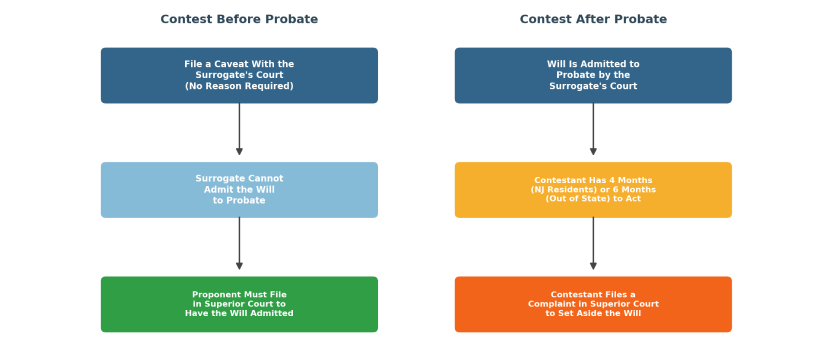
General overview. Specific deadlines and requirements can vary by case.
Filing a Caveat Before Probate
A caveat is a short, signed statement filed with the Surrogate’s Court stating that someone contests the will. It does not need to explain why.
Once filed, the Surrogate cannot admit the will to probate. The person named as executor must instead file an action in Superior Court to have the will admitted, which gives the contestant a formal opportunity to raise objections.
A caveat is a powerful tool, but you should not file it lightly. Some wills contain a no contest clause that can reduce or eliminate a beneficiary’s inheritance if that beneficiary contests the will without probable cause, and New Jersey courts have found that filing a caveat can itself count as a contest for this purpose.
Contesting a Will After Probate
If the will has already been admitted to probate, a contestant can still challenge it, but only within a limited window.
New Jersey law generally gives a resident four months from the date of probate to file a complaint in Superior Court, and six months if the contestant lives outside New Jersey.
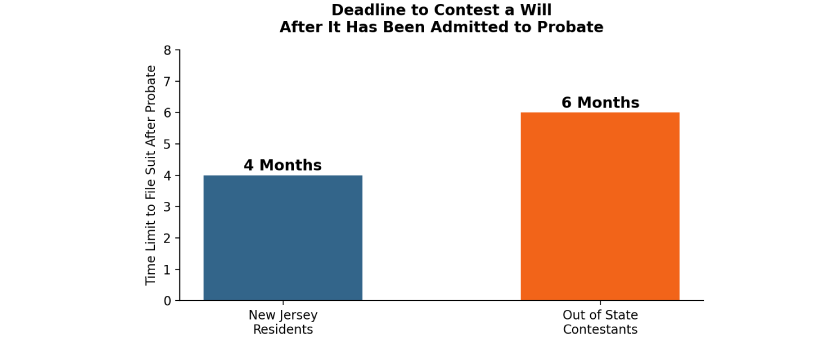
Deadline to file a will contest after probate, measured from the date the will was admitted.
Missing this deadline generally ends the ability to contest the will at all, regardless of how strong the underlying claim may be.
Grounds for Contesting a Will or Trust
New Jersey recognizes several distinct legal grounds for challenging a will or trust, and each one requires proving something different.
Will Contests
A will contest challenges the document’s validity as a whole, often based on improper execution, a later will that revoked it, or one of the specific grounds described below.
New Jersey requires a will to be signed by the testator and witnessed by two people in the testator’s presence. A will that does not meet these formalities can be challenged on execution grounds alone, separate from any question about the testator’s intent.
A will contest can also be based on the existence of a later will that revoked the one being probated, on fraud in how the document was presented for signature, or on a claim that the signature itself is not genuine. Each of these theories requires different evidence, and more than one can apply to the same document.
Trust Litigation and Disputes
Trust disputes cover a wide range of disagreements, including a trust’s validity, whether it was properly funded, and whether a trustee is administering it correctly.
Because a trust generally does not go through the Surrogate’s Court, trust disputes typically start directly in the Superior Court’s Chancery Division rather than beginning with a caveat.
A trust dispute can also involve disagreements between co-trustees, questions about whether a trust was properly amended before the grantor’s death, or a claim that a trust was created or modified while the grantor lacked capacity. Irrevocable trusts, including the dynasty and education trust structures used in many Bergen County estate plans, can still be challenged on these grounds even though they are designed to be difficult to unwind under ordinary circumstances.
Undue Influence Claims
Undue influence exists when a will or trust reflects the wishes of someone other than the person who signed it, usually because of excessive pressure from a person in a position of trust.
Ordinarily, the person challenging the document has to prove undue influence occurred. New Jersey law shifts that burden in specific circumstances.
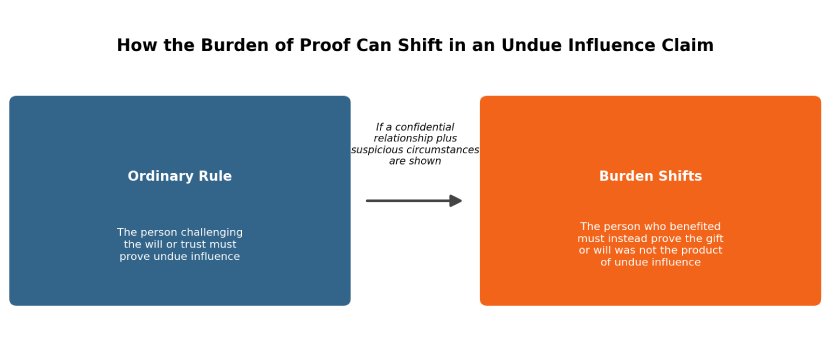
A simplified overview of New Jersey’s burden shifting framework for undue influence claims.
When the person who benefited from the will or trust had a confidential relationship with the person who signed it, such as a caregiver, an agent under a power of attorney, or someone who arranged for the document to be prepared, and suspicious circumstances surround the signing, the burden shifts to that beneficiary to prove the document was not the product of undue influence.
Suspicious circumstances can include a dramatic, unexplained change from a prior estate plan, isolation of the person who signed from other family members, or direct involvement by the beneficiary in arranging for the document to be drafted and signed.
Lack of Testamentary Capacity Claims
A person must have testamentary capacity at the moment they sign a will for it to be valid. New Jersey sets this bar relatively low.
The person generally needs to understand, at a basic level, what property they own, who would naturally be expected to inherit it, such as a spouse or children, and that they are signing a document that directs how that property will be distributed.
A diagnosis such as dementia does not automatically mean a person lacked capacity. Capacity is evaluated at the specific moment of signing, and a person can have periods of clarity even amid a broader cognitive decline. Medical records and witness testimony about that specific day often become central to these cases.
Breach of Fiduciary Duty
An executor or trustee owes fiduciary duties to the beneficiaries they serve, including loyalty, impartiality, and reasonable care in managing estate or trust assets.
A breach of fiduciary duty claim might allege that an executor mismanaged assets, favored one beneficiary over another, failed to account properly, or used estate or trust funds for personal benefit.
A beneficiary who succeeds on this type of claim can seek removal of the fiduciary, a surcharge requiring the fiduciary to personally repay losses caused by the breach, and in some cases an award of attorney fees.
Evidence That Strengthens an Estate Litigation Case
Estate litigation often comes down to reconstructing events from before the person died, sometimes years before, which makes the type of evidence gathered especially important.
Medical records from around the time a will or trust was signed can support or undermine a capacity claim, particularly notes from a treating physician describing the person’s cognitive state on or near that date.
The attorney who drafted the will or trust is often a key witness. That attorney’s file typically includes notes from the initial meeting, drafts showing how the document changed over time, and observations about who was present during the signing, including whether a beneficiary who stood to gain was involved in arranging or attending the meeting.
Bank and financial records can reveal a pattern of transfers, new account arrangements, or changes in a power of attorney that took place around the same time as the disputed will or trust, which can support both undue influence and elder financial abuse claims.
Witnesses who interacted with the person regularly, including friends, other family members, home health aides, and clergy, can speak to the person’s mental state, their relationships, and whether their stated wishes matched what the challenged document actually says.
Deposing the Attorney Who Drafted the Document
When the attorney who drafted a contested will or trust is available, their deposition is often one of the most important steps in the entire case.
That attorney can typically testify about who first contacted them to arrange the appointment, whether the person who ultimately benefited was present during confidential discussions about the estate plan, and whether the client’s stated wishes at the time matched what the final document says. New Jersey does not treat this testimony as covered by attorney client privilege once the client has passed away and the validity of their own estate plan is at issue.
A drafting attorney’s contemporaneous notes, taken at the time the plan was being discussed, often carry more weight than anyone’s memory of events years later, which is one reason preserving that file quickly matters once a dispute looks likely.
Requesting that file early, before memories fade and before the drafting attorney’s own recollection becomes less reliable, is one of the first practical steps in building a strong case on either side of a capacity or undue influence claim.


Elder Financial Abuse and Estate Litigation
Estate disputes sometimes surface a broader pattern of elder financial abuse that began well before the person died.
A caregiver, new acquaintance, or even a family member who gains control over an older adult’s finances through a power of attorney can misuse that authority to drain accounts, retitle property, or pressure changes to a will or trust, all before anyone else in the family realizes what is happening.
New Jersey allows a civil claim for financial exploitation of a vulnerable adult, which can run alongside an undue influence or breach of fiduciary duty claim brought after the person has passed away. In some cases, filing a report with New Jersey’s Adult Protective Services while the older adult is still alive can prevent further loss and preserve evidence that becomes important later.
Families who suspect this kind of abuse while a parent or relative is still living should not wait for a will contest to become the only remedy. Immediate legal action, including a possible guardianship or power of attorney challenge, can stop ongoing harm.
Cost and Timeline Considerations
Estate litigation costs vary enormously based on how contested the case becomes and how far it proceeds before resolution.
A case resolved early through negotiation, once each side understands the strength of the evidence, costs considerably less than one that proceeds through full discovery and trial. Depositions, medical record subpoenas, and, in some cases, expert witnesses on capacity or handwriting can add meaningfully to the cost of a fully litigated case.
Timeline follows a similar pattern. A straightforward dispute that settles after initial discovery might resolve within several months. A fully litigated will contest involving competing medical experts and multiple depositions can take a year or more before trial.
Attorney Banks discusses realistic cost and timeline expectations at the outset of a case, based on the specific facts involved, rather than offering a generic estimate that does not account for how contested the matter is likely to become.
Grounds Comparison
The table below summarizes what a contestant generally has to prove for each type of claim, and where the burden of proof typically starts.
| Claim | What Must Generally Be Shown | Where the Burden Starts |
|---|---|---|
| Will Contest (Execution) | The will was not properly signed or witnessed under New Jersey law | On the contestant |
| Undue Influence | A confidential relationship and suspicious circumstances surrounding the signing | Shifts to the beneficiary once shown |
| Lack of Testamentary Capacity | The person did not understand their property, natural heirs, or the act of signing a will | On the contestant |
| Trust Dispute | The trust is invalid, was not properly funded, or is being administered improperly | Varies by the specific claim |
| Breach of Fiduciary Duty | The executor or trustee violated a specific duty owed to beneficiaries | On the beneficiary bringing the claim |
How an Estate Litigation Case Proceeds
Once a genuine dispute is underway, most Bergen County estate litigation matters follow a similar general path through the court system.
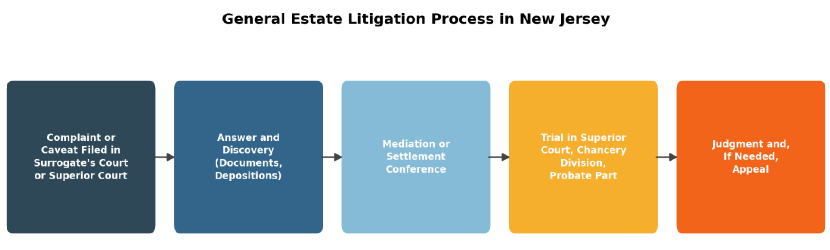
General sequence for a contested estate or trust matter in New Jersey. Individual cases vary.
Discovery is often the longest phase. Parties exchange financial records, medical records, and correspondence, and depose witnesses who were present when a will or trust was signed, including the attorney who drafted it.
Many cases resolve at mediation or a settlement conference rather than proceeding to trial. A negotiated resolution can preserve family relationships and avoid the cost and unpredictability of a trial, though it is not always possible or appropriate.
Cases that do not settle proceed to trial before a judge in the Superior Court’s Chancery Division, Probate Part. New Jersey estate litigation is generally tried without a jury.
A party who disagrees with the trial court’s ruling can appeal to the Appellate Division, though an appeal generally has to be based on a legal or procedural error rather than simple disagreement with how the judge weighed the evidence. Appeals add significant time, often a year or more, before a matter is finally resolved.
Who Pays the Legal Fees in a Will Contest
New Jersey generally follows the American Rule, meaning each side pays its own attorney fees regardless of who wins.
Will contests carry a specific, limited exception. Under New Jersey Court Rule 4:42-9(a)(3), if the will is ultimately admitted to probate but the court finds the contestant had reasonable cause for bringing the challenge, the court can award attorney fees to both the proponent and the contestant, paid out of the estate itself.
This exception exists because New Jersey courts recognize that legitimate concerns about a will’s validity serve a public interest, even when the contest is ultimately unsuccessful. It does not apply to contests brought without any real factual basis.
Whether reasonable cause existed is a fact-specific determination the judge makes after hearing the evidence, which means the same underlying facts that determine whether the will is valid also determine whether fees get shifted at all.
A related issue arises when a will contains a no contest clause. New Jersey generally will not enforce this type of clause against a beneficiary who had probable cause for the contest, even if that contest fails, though a contest brought with no supporting evidence can trigger forfeiture under the clause.
Deciding whether to file a caveat when a will contains a no contest clause is a decision worth making with legal advice rather than on your own, given what filing without probable cause could cost you under the clause itself.
Attorney Banks reviews any no contest language in the specific will at issue before advising a client on whether and how to proceed, since the wording of these clauses varies and some are broader than others.
Removing an Executor or Trustee
A beneficiary who believes an executor or trustee is mismanaging an estate or trust has options short of waiting until final distribution.
New Jersey courts can remove a fiduciary for cause, including self-dealing, failure to account, ongoing mismanagement of assets, or an inability or unwillingness to carry out the fiduciary’s duties.
A removal action often proceeds alongside a breach of fiduciary duty claim, since the same conduct that justifies removal frequently also supports a surcharge for losses the estate or trust already suffered.
Removal is a significant step, and New Jersey courts generally do not grant it for minor disagreements or personality conflicts alone. The conduct at issue typically has to threaten the estate or trust’s assets or the fiduciary’s ability to act impartially.
A court can appoint a temporary or substitute fiduciary while a removal action is pending if there is a genuine risk that assets could be lost or dissipated before the case is resolved. Beneficiaries do not always have to wait for a final ruling if the situation is urgent enough.
Guardianship Disputes Connected to Estate Matters
Estate litigation sometimes traces back to a guardianship dispute that began while the person was still alive.
A guardianship gives one person legal authority over an incapacitated adult’s finances, healthcare decisions, or both. Family members sometimes disagree over who should serve as guardian, and a guardian who was appointed improperly or exceeded their authority can leave a trail of transactions that later becomes relevant to an estate or trust dispute after the person passes away.
A guardian’s actions taken under a court-appointed authority can themselves be challenged in the Superior Court, separate from any later estate litigation, and doing so promptly can prevent further harm while also preserving evidence relevant to a future claim.
Settlement Agreements in Estate Litigation
Many Bergen County estate disputes resolve through a negotiated settlement rather than a judge’s final ruling.
A settlement can restructure how assets are ultimately distributed, resolve a contested accounting without admitting wrongdoing, or replace a disputed fiduciary with one acceptable to all parties. Settlements are generally submitted to the court for approval, particularly when a minor or incapacitated beneficiary is involved.
A well-drafted settlement addresses not just the immediate dispute but also releases future claims arising from the same underlying facts, preventing the same disagreement from resurfacing later in a different form.
Contested Accountings
An executor or trustee must provide beneficiaries with a formal accounting showing what came into the estate or trust, what was paid out, and what remains.
A beneficiary who believes that accounting is incomplete, inaccurate, or hiding something can file a formal objection, called an exception, forcing the fiduciary to justify specific entries in court.
Contested accounting cases often turn on documentation. A fiduciary who kept clear, organized records is in a far stronger position than one who cannot explain a specific expense or transfer.
A beneficiary does not have to prove actual wrongdoing simply to force an accounting. New Jersey law gives beneficiaries a right to a periodic accounting, and a fiduciary’s refusal to provide one is itself grounds for a court order compelling it, separate from any underlying claim of misconduct.
Common Questions About Whether You Have a Case
Families often are not sure whether what they are seeing rises to the level of a legal claim. A few patterns are worth a closer look.
A will that dramatically favors a new caregiver, a recent acquaintance, or one child over others, especially if it departs sharply from a long-standing prior estate plan, is worth reviewing.
An executor who will not provide an accounting, will not answer basic questions, or appears to be delaying distribution without explanation raises legitimate concern.
A parent who signed a new will or changed beneficiary designations shortly before death, particularly while under the day-to-day care of the person who benefited from the change, fits a pattern New Jersey courts take seriously.
A sudden change in who holds power of attorney, followed by unusual account activity or a new will naming that same person as primary beneficiary, is a pattern worth investigating even before litigation becomes necessary.
An executor who sells estate property to a family member or associate for less than market value, or who pays themselves fees beyond the statutory commission without explanation, raises a clear breach-of-fiduciary-duty concern.
None of these patterns guarantees a successful claim on its own, but each is a reasonable basis for a consultation to review the specific facts.
A general sense that a will or an executor’s conduct simply does not feel right is also worth raising in a consultation. Attorneys who handle these cases regularly can often spot a real issue in the details a family member might not know to mention.
Why the Same Attorney Who Handles Estate Planning Also Handles Litigation
Some firms only draft wills and trusts. Others only litigate disputes after something has already gone wrong. Attorney Banks does both, and each side of the practice informs the other.
Drafting experience means understanding exactly which clauses tend to get challenged, which language holds up under cross examination, and which documentation habits protect a fiduciary later. Litigation experience means knowing, from direct courtroom experience, which arguments actually persuade a Bergen County judge and which ones sound better in theory than they work in practice.
For a client currently drafting a plan, this means fewer ambiguities left for a future dispute to exploit. For a client already in a dispute, it means an attorney who is not encountering estate law concepts for the first time under pressure.
This matters even for families who came to Attorney Banks first for planning and only later found themselves in a dispute, since the same attorney who understands the original intent behind a plan is often best positioned to defend or explain it years later.
If You Are Facing an Estate Dispute in Bergen County
Whether you are contesting a will, defending one, or caught in a dispute over how an estate or trust is being managed, the deadlines involved make early legal advice especially important.
A four month window to contest a will after probate passes quickly, and evidence such as medical records and witness memories only grow harder to gather with time.
Attorney Banks has represented clients on both sides of contested estates throughout Bergen County’s Surrogate’s Court and Superior Court. Call 201-483-2338 to discuss your situation, or complete the online questionnaire to begin on your own schedule.
Frequently Asked Questions
Common Concerns About Pursuing an Estate Dispute
“Contesting the will could tear my family apart.”
A dispute that is already causing tension within the family often exists whether or not a legal claim is filed. Getting clear answers through the proper legal process can resolve uncertainty faster than letting suspicion and resentment build without resolution.
“I do not have solid proof, just a feeling something was wrong.”
Many valid claims begin exactly this way. An initial consultation can help determine whether the specific facts, medical history, and timeline support a legal claim before you commit to litigation.
“It is not worth fighting over what is a relatively small inheritance.”
The value of the inheritance is one factor, but so is the cost of litigation itself, which an attorney can estimate honestly before you decide whether pursuing a claim makes practical sense.
“Too much time has already passed.”
Some deadlines, particularly the four- and six-month windows to contest a will after probate, are strict. Others, involving trust administration or ongoing fiduciary misconduct, may still be available. Confirm your specific situation rather than assuming it is too late.
What Happens When You Call
Reaching out starts with a free initial phone call or meeting.
Before that call, you’ll complete a short questionnaire describing the situation, including any documents you already have, such as the will in question or prior correspondence with the executor.
During the call, Attorney Banks reviews the specific facts and timeline, flags any deadlines that may already be running, and explains what a case like yours would generally involve. Most calls end with a clear next step and an exact fee quote in writing.
Get Answers About Your Estate Dispute
Estate litigation deadlines do not wait for family disputes to resolve on their own.
Whether you are weighing whether to file a caveat, already deep into a contested accounting, or simply trying to understand whether what you are seeing is normal or a sign something is genuinely wrong, an honest conversation about your specific facts is the right next step.
Call Patrick Banks Law at 201-483-2338 to schedule your free initial consultation and find out where your case actually stands.
