



An executor or trustee breaches their fiduciary duty when they put their own interests first, mismanage assets, refuse to account, or fail to follow the will or trust. In New Jersey, beneficiaries can ask the Superior Court to compel an accounting, surcharge the fiduciary for losses, reduce their commission, or remove them.
Patrick Banks Law represents Bergen County beneficiaries and fiduciaries in these disputes.
When someone dies, their family trusts the executor or trustee to handle the estate or trust honestly. Most fiduciaries do. Some do not.
Whether the problem is a sibling who will not share bank statements, a trustee who treats trust money as their own, or an estate that has sat untouched for years, New Jersey law gives beneficiaries real tools to protect themselves. This page explains what counts as a breach, how to recognize the warning signs, and what courts can do about it. For the broader picture of these disputes, see our Bergen County estate litigation overview.
What Is a Fiduciary Duty?
A fiduciary is someone legally required to act for others’ benefit. Executors, administrators, and trustees are all fiduciaries.
An executor manages a probate estate under a will and answers to the Surrogate’s Court and the Superior Court. A trustee manages assets held in a trust and answers to the trust document and New Jersey’s trust code.
Although their roles differ, both owe the same core duties to the people they serve.
- Loyalty. Act solely in the beneficiaries’ interests and avoid conflicts of interest.
- Prudence. Manage and invest assets with reasonable care, skill, and caution. New Jersey’s Prudent Investor Act sets the standard for how fiduciaries invest.
- Impartiality. Treat beneficiaries fairly according to the terms of the will or trust.
- Disclosure and accounting. Keep beneficiaries reasonably informed and maintain complete records.
- Obedience. Follow the instructions in the will or trust document.
Our guide to executor duties and responsibilities walks through what a properly run estate looks like, step by step.
How Executor and Trustee Breaches Differ
Executor disputes usually arise during a defined window. An estate is opened, administered, and closed, often within one to two years, so problems tend to involve delay, missing assets, debts, taxes, and the final distribution.
Trustee disputes can stretch across decades. A trust may hold assets for a surviving spouse and then for children or grandchildren, which means investment performance, discretionary distributions, and ongoing reporting become the focus.
The paperwork also differs. Executors typically report through the Surrogate and the probate court, while trustees operate largely outside court supervision unless someone asks a judge to step in.
That lack of oversight is exactly why a trust beneficiary’s right to information matters so much. Without regular reports, a trustee’s mistakes or misconduct can go unnoticed for years.

Common Examples of Fiduciary Breach
Breaches range from outright theft to careless mistakes. Courts look at both intent and results, and a fiduciary can be liable even without bad intentions.
Self-Dealing
Self-dealing happens when a fiduciary benefits personally from estate or trust transactions. Selling the family home to themselves or a relative below market value, borrowing trust money, or hiring their own business to do estate work are classic examples.
New Jersey courts closely scrutinize these transactions. A fiduciary on both sides of a deal must show it was fair.
Commingling and Misappropriation
Estate and trust money must be kept separate. Depositing estate funds into a personal account, paying personal bills from the estate, or using estate property for personal benefit can be a breach, even if the fiduciary intends to pay it back.
Refusing to Account or Share Information
Beneficiaries have a right to know what is happening. A fiduciary who ignores requests for information, will not provide bank statements, or refuses to prepare an accounting is often hiding something, or at minimum is failing a basic duty.
Unreasonable Delay
Some estates take time. But an executor who does nothing for years, fails to file tax returns, or lets property sit vacant and deteriorating may be breaching the duty of care.
Imprudent Management
Letting insurance lapse on a vacant house, leaving large sums uninvested for long periods, or making speculative investments can expose a fiduciary to liability when the estate or trust loses value.
Favoritism and Ignoring the Document
A fiduciary who distributes assets unevenly, gives some beneficiaries information while withholding it from others, or rewrites the will’s instructions to suit their own view of fairness is violating the duty of impartiality.
Warning Signs Beneficiaries Should Watch For
- The executor or trustee stops returning calls or emails
- Requests for statements or an accounting are ignored or answered vaguely
- Estate property is being used by the fiduciary or their family
- A house or business is sold quickly without an appraisal or to someone connected to the fiduciary
- Months pass with no probate, tax filings, or visible progress
- The fiduciary pays themselves large fees without explanation
- Assets you knew existed are missing from any inventory
Any one of these signs may have an innocent explanation. Several together usually mean it is time to get legal advice.
Your Rights as a Beneficiary in New Jersey
Beneficiaries are not powerless observers. Under New Jersey law, you generally have the right to:
- Receive notice of probate and a copy of the will
- Request information about estate or trust assets and administration
- Receive an accounting, and ask the court to compel a formal one
- File written exceptions objecting to specific items in an accounting
- Ask the court to remove a fiduciary who is not performing
For trusts, New Jersey’s version of the Uniform Trust Code requires trustees to keep qualified beneficiaries reasonably informed about the trust and its administration. Our page on trust administration explains what trustees must do once a trust becomes irrevocable.


How a Breach of Fiduciary Duty Claim Works
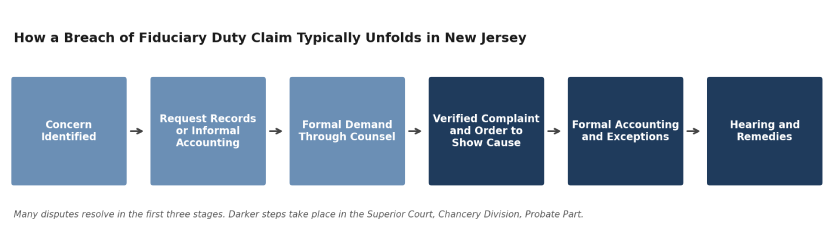
Most disputes begin informally. A written request for records, followed by a formal demand letter from counsel, resolves many concerns without court involvement.
When that does not work, a beneficiary can file a verified complaint and order to show cause in the Superior Court, Chancery Division, Probate Part. In Bergen County, Hackensack hears these matters. The probate court moves on a summary basis, which can be faster than ordinary civil litigation.
A common first step is asking the court to compel the fiduciary to file a formal accounting. Once it is filed, beneficiaries can file exceptions challenging specific transactions, and the court resolves those disputes.
Remedies Courts Can Order
New Jersey courts have broad power to fix fiduciary misconduct. The remedy depends on what went wrong and how much harm it caused.
| Remedy | What It Does | When Courts Commonly Use It |
|---|---|---|
| Compelled formal accounting | Requires the fiduciary to document every asset, receipt, expense, and distribution under oath | The fiduciary refuses to share information or records are incomplete |
| Surcharge | Orders the fiduciary to personally repay losses, often with interest | Assets were wasted, misused, or sold below value |
| Removal | Replaces the executor or trustee with a new fiduciary | Mismanagement, failure to act, or a conflict that harms the estate or trust |
| Reduction or denial of commission | Cuts or eliminates the fiduciary’s statutory compensation | The fiduciary failed to perform properly or acted in bad faith |
| Setting aside transactions | Undoes a sale, transfer, or distribution | Self-dealing or a transfer that violated the will or trust |
| Fee shifting | May require the wrongdoer to bear counsel fees | Certain cases involving fraud or undue influence by a fiduciary |
The most common financial remedy is a surcharge, which requires the fiduciary to repay the estate or trust from their own funds. The example below shows how a surcharge might be measured in a self-dealing sale.
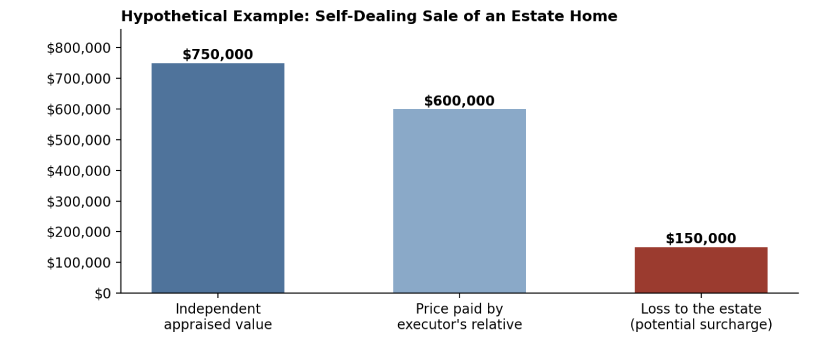
Hypothetical illustration only. Actual surcharges depend on the facts, the evidence of value, and the court’s findings, and may include interest.
In New Jersey, the general rule is that each side pays its own attorney fees. However, the New Jersey Supreme Court’s decision in In re Estate of Niles recognized that a fiduciary who commits undue influence or fraud can be ordered to pay counsel fees incurred by beneficiaries. Court rules also allow fees to be paid from the estate in certain probate matters.
Deadlines and Why Timing Matters
Time limits for fiduciary claims depend on the type of claim, whether it involves an estate or a trust, and what the beneficiary knew and when.
For trusts, New Jersey’s trust code can sharply shorten the time to bring a claim once a trustee sends a report that adequately discloses a potential problem. Beneficiaries who sign releases or refunding bonds at the end of an estate may also limit their ability to object later.
Delay has practical costs, too. Money already spent is harder to recover, and records become harder to obtain. If you suspect a breach, act promptly.
When the Fiduciary Is the One Accused
Not every accusation is justified. Executors and trustees often face complaints from grieving beneficiaries who misunderstand the process or disagree with the will itself.
If you are an executor or trustee facing allegations, a complete, well-documented accounting is often the strongest defense. Following the will or trust document, keeping good records, and communicating regularly with beneficiaries protect you from most claims.
Patrick Banks Law represents fiduciaries who need to respond to accusations, as well as beneficiaries who need to hold a fiduciary accountable.
How Breach Claims Connect to Other Estate Disputes
Fiduciary disputes often overlap with other estate litigation. A trustee accused of misconduct may also be accused of pressuring the deceased person to change their plan, raising undue influence issues. A family member who believes the will itself is invalid may pursue a will contest alongside or instead of a fiduciary claim.
Careful planning can prevent many of these disputes, including choosing the right executor or trustee in the first place. Our Bergen County estate planning page explains how thoughtful fiduciary selection protects your family.
Worried that an executor or trustee is mishandling a Bergen County estate or trust? Attorney Patrick V. Banks has handled estate litigation throughout Bergen County since 2007. Call 201-483-2338 to schedule your free initial consultation.
Frequently Asked Questions About Fiduciary Breach in New Jersey
What Happens When You Call Patrick Banks Law
When you call 201-483-2338, you will complete a short questionnaire about the estate or trust, your relationship to it, and any concerns you have noticed.
Attorney Banks then reviews your situation, including any documents you already have. Most calls end with a clear recommended next step and a written fee quote.
Protect Your Inheritance or Your Role as Fiduciary
A breach of fiduciary duty can drain an estate or trust that a loved one spent a lifetime building. Acting early gives you the best chance to recover losses and stop further harm.
Patrick Banks Law represents beneficiaries and fiduciaries in Ridgewood, Upper Saddle River, and throughout Bergen County.
Call 201-483-2338 or complete our online questionnaire to schedule your free initial consultation.
