



In New Jersey, each county’s Surrogate handles uncontested probate. The Surrogate admits wills to probate, appoints executors and administrators, and issues short certificates that allow them to act for the estate.
A will can be probated 10 days after death. Disputes move to the Superior Court, Chancery Division, Probate Part. Bergen County residents use the Surrogate’s Court in Hackensack.
For many families, the Surrogate’s Court is the first stop after a loved one passes. It can feel intimidating, but the process is more administrative than adversarial.

This article walks through what the Surrogate does, how to prepare for your appointment, and what happens next. For the full picture of settling an estate, see our overview of Bergen County estate administration.
What the Surrogate Does
Every New Jersey county elects a Surrogate. The Surrogate is a constitutional officer who handles probate matters without dispute.
In practice, the Surrogate’s office:
- Admits wills to probate
- Appoints executors by issuing letters testamentary
- Appoints administrators when there is no will
- Issues short certificates confirming a fiduciary’s authority
- Keeps records such as refunding bonds, releases, and proof of notice
- Handles certain guardianship matters and holds some funds for minors
The Surrogate does not decide disputes. If someone challenges a will or objects to an appointment, a Superior Court judge takes over.
Where to Go in Bergen County
The Surrogate’s Court in the county where the deceased person lived handles the estate. For Bergen County residents, that is the Bergen County Surrogate’s Court at Two Bergen County Plaza, Fifth Floor, in Hackensack.
Call ahead before you go. Most probate matters are handled by appointment, and office procedures, fees, and payment options can change.
Which Path Applies to Your Situation
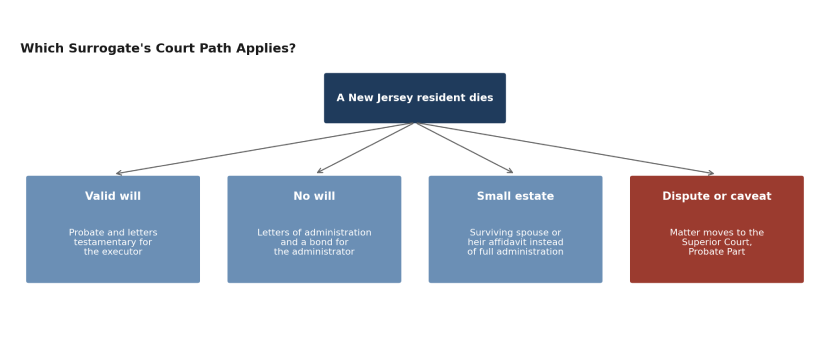
The process depends on whether there is a valid will, how large the estate is, and whether anyone objects.
When There Is a Will
The executor named in the will applies to have it admitted to probate. New Jersey requires a waiting period of at least 10 days after death before this can happen.
A self-proving will, signed with a notarized affidavit from the witnesses, can usually be probated without the witnesses appearing. If the will is not self-proving, the Surrogate may require additional proof that it was properly signed.
Once the will is admitted, the Surrogate issues letters testamentary. Many wills waive the requirement for an executor to post a bond.
When There Is No Will
If someone dies without a will, a family member applies for letters of administration. New Jersey law sets the order of priority, generally starting with a surviving spouse or domestic partner and then other heirs.
Courts generally do not issue letters of administration until at least 40 days after death. Other heirs with an equal or higher right to serve may need to sign renunciations, and the administrator usually must post a surety bond.
When the Estate Is Small
New Jersey offers simplified procedures for small estates. A surviving spouse or domestic partner may be able to collect up to $50,000 by affidavit, and other heirs may be able to collect up to $20,000, without full administration.
These affidavits are filed with the Surrogate and can save significant time for modest estates.
When Someone Objects
Anyone who wants to challenge a will before it is probated can file a caveat with the Surrogate. A caveat stops the Surrogate from admitting the will until the dispute is resolved.
At that point, the matter moves to the Superior Court, Chancery Division, Probate Part. Our page on will contests explains how those cases work.
Preparing for Your Appointment
A little preparation can turn your appointment into a single, efficient visit.
| What to Bring | Why the Surrogate Needs It |
|---|---|
| The original signed will and any codicils | Copies generally cannot be probated without a separate court proceeding |
| A certified death certificate | Confirms the date of death and that the person lived in the county |
| Your photo identification | Confirms you are the executor named in the will |
| Names and addresses of beneficiaries and next of kin | Needed for the notice of probate that must be mailed after the will is admitted |
| An estimate of the estate’s value | Helps the Surrogate prepare the paperwork and determine fees |
| Payment for filing fees and short certificates | Fees are set by statute and vary with the length of the will |
Many executors order several short certificates at the appointment. Each bank, brokerage, insurance company, and government agency may want its own.
What Happens After You Are Appointed
Leaving the Surrogate’s office with your short certificates is the beginning of the job, not the end. The timeline below shows several key deadlines.
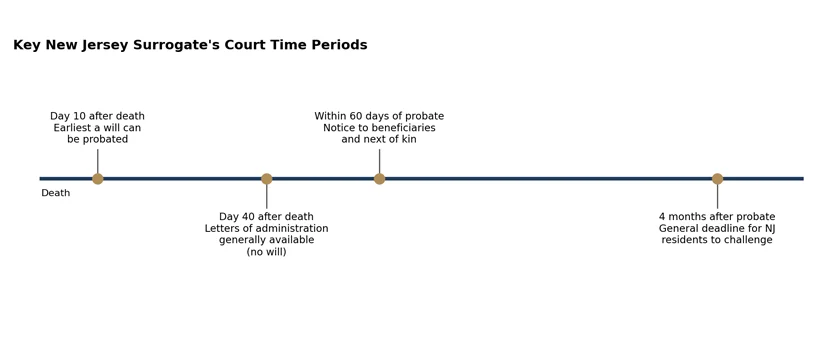
Time periods are approximate and depend on the circumstances of each estate.
Sending Notice of Probate
Within 60 days after the will is admitted to probate, the executor must mail notice to beneficiaries and certain next of kin. The executor then files proof of that mailing with the Surrogate.
The Window to Challenge the Will
After probate, New Jersey residents generally have four months to challenge the will in the Superior Court. People who live outside New Jersey generally have six months. These deadlines can be extended only in limited situations.
Administering the Estate
Once appointed, the executor secures assets, pays debts and taxes, keeps records, and distributes what remains. Our guide to executor duties and responsibilities walks through each step. Tax filings, including the New Jersey inheritance tax return, are covered on our inheritance tax page.
Closing Out With the Surrogate
At the end of administration, beneficiaries typically sign refunding bonds and releases when they receive their shares. These documents are filed with the Surrogate and help protect the executor from future claims.
Common Mistakes at the Surrogate’s Court
- Bringing a copy of the will instead of the original
- Applying before the 10-day waiting period has passed
- Ordering too few short certificates
- Missing the 60-day deadline to mail notice of probate
- Assuming the Surrogate’s appointment ends the executor’s responsibilities
- Acting on estate accounts before letters are issued
Can You Avoid the Surrogate’s Court Entirely?
Some assets never pass through the Surrogate’s Court. Jointly owned property, accounts with named beneficiaries, and assets held in a funded trust usually transfer directly.


Families who want to keep their affairs private or simplify administration often use a revocable living trust. Our page on revocable trusts explains how that planning works.
Preparing for a Bergen County Surrogate’s Court appointment? Attorney Patrick V. Banks has guided Bergen County executors and families through probate since 2007. Call 201-483-2338 to schedule your free initial consultation.
Frequently Asked Questions About the New Jersey Surrogate’s Court
Get Help With the Probate Process
The Surrogate’s Court is only one part of settling an estate, and knowing what comes next makes the whole process easier. Patrick Banks Law helps executors and families in Ridgewood, Upper Saddle River, and throughout Bergen County. Learn more about the full New Jersey probate process.
Call 201-483-2338 or complete our online questionnaire to schedule your free initial consultation.
