


A Bergen County probate attorney handles the estate problems the Surrogate’s office cannot solve on its own. That includes a will that only exists as a copy, an estate with no will, a family home that must be sold, property in New York, and claims from creditors or the State.
Many estates move through probate smoothly. When yours doesn’t, Patrick Banks Law can review the estate and tell you exactly what’s in the way.
Probate in Bergen County usually starts with a short appointment at the Surrogate’s office in Hackensack. For many families, that is where the real work begins, not where it ends.
Attorney Patrick V. Banks has represented executors, administrators, and heirs across Bergen County since 2007. This page explains the probate situations that call for an attorney, how New Jersey law handles them, and how our firm moves a stalled estate forward.

For a broader overview of settling an estate from start to finish, our Bergen County estate administration page covers it. Here, the focus is narrower: the legal problems that turn routine probate into something more.
When a Bergen County Estate Needs a Probate Attorney
New Jersey does not require anyone to hire a lawyer for probate. A family with an original, self-proving will, a cooperative set of heirs, and only bank accounts to collect may never need one.
The picture changes quickly when certain facts are present. The table below sorts the most common warning signs by how often they push an estate outside the Surrogate’s routine process.
| Situation in the Estate | Why It Complicates Probate | Typical Next Step |
|---|---|---|
| Only a photocopy of the will can be found | The Surrogate cannot admit a copy to probate | Court action in the Probate Part |
| Will was signed without proper witnesses | The document may still qualify, but only with court approval | Proof by clear and convincing evidence |
| No will, and heirs disagree on who should serve | Competing claims to letters of administration | Hearing before a Superior Court judge |
| An heir cannot be found or will not respond | Notice and consent requirements cannot be met | Court-ordered notice or search |
| The deceased owned a home or condo in New York | New Jersey letters do not control New York real estate | Ancillary filing in New York |
| The deceased received Medicaid after age 55 | The State may hold a claim against the estate | Review and negotiation of the claim |
Any one of these issues can add months to an estate. Two or more together is a strong signal to get legal guidance before anyone signs, sells, or distributes anything.
Probate Matters That Go Beyond the Surrogate’s Office
The Bergen County Surrogate handles uncontested probate. Our guide to the New Jersey Surrogate’s Court process explains what happens at that appointment.
Anything the Surrogate cannot approve on paperwork alone goes to a judge. In Bergen County, that judge sits in the Superior Court, Chancery Division, Probate Part, at the Bergen County Justice Center, 10 Main Street, Hackensack.
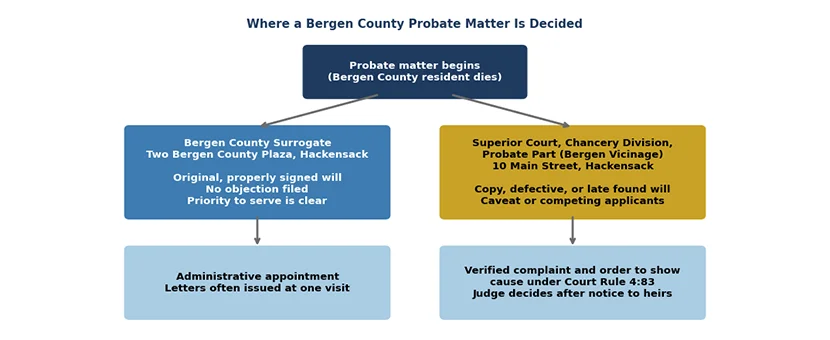
Simplified routing of Bergen County probate matters. Individual cases may follow a different path.
Cases in the Probate Part generally begin with a verified complaint and an order to show cause under New Jersey Court Rule 4:83. Heirs and beneficiaries receive notice, and the judge sets a return date to hear the matter.
These are the situations our firm sees most often in that courtroom.
Only a Copy of the Will Can Be Found
Families often find a copy of a will in a desk drawer while the signed original is nowhere to be found. The Surrogate requires the original, so a copy cannot simply be filed.
New Jersey law presumes that a person who kept their original will and later lost track of it may have revoked it on purpose. To probate the copy, the person offering it must overcome that presumption with evidence about where the original went and what the deceased intended.
We gather that evidence. It may include testimony from the attorney who prepared the will, records from a storage box or safe deposit box, and statements showing the deceased never meant to cancel the document.
A Will With Signing Defects or a Handwritten Document
A will usually needs two witnesses. Under N.J.S.A. 3B:3-3, a document that does not meet those formalities can still be treated as a valid will if the person offering it proves, by clear and convincing evidence, that the deceased intended it to be their will.


This rule has covered unsigned drafts, handwritten notes, and documents with only one witness. The standard is demanding, and the outcome depends heavily on the surrounding facts, so preparation matters.
A Will Discovered After Administration Has Started
Sometimes a family member opens an intestate estate in good faith, and a will turns up months later. The letters of administration already issued do not simply disappear.
The newly found will has to be offered for probate, the prior appointment may need to be revoked, and anything already distributed may have to be reconciled with the will’s terms. We coordinate that transition so the person who acted in good faith is protected.
Disagreement Over Who Should Serve
When there is no will, New Jersey gives a surviving spouse or domestic partner first priority to serve as administrator, followed by other heirs. Problems arise when two adult children each want the role, or when a family member objects to the person with priority.
If the heirs cannot agree, the Surrogate cannot pick a winner. A judge decides, and the court can appoint a neutral administrator when family relationships make that the safer choice.
Heirs Who Cannot Be Located
Every heir has a legal right to notice. An estranged sibling, a relative living overseas, or a cousin whose address is unknown can stop an estate from closing.
We conduct and document a diligent search. When an heir still cannot be found, we ask the court how to give notice and how to hold that person’s share, so the rest of the family is not left waiting indefinitely.
Who Inherits When There Is No Will in New Jersey
When someone dies without a will, New Jersey’s intestacy statute decides who receives the estate. Many families are surprised to learn that a surviving spouse does not always inherit everything.
Under N.J.S.A. 3B:5-3, the spouse takes the entire estate only when every child of the deceased is also the spouse’s child and the spouse has no children from another relationship. The spouse also takes everything when no descendant and no parent survives.
In other families, the spouse receives the first 25 percent of the estate, with a floor of $50,000 and a ceiling of $200,000, plus a fraction of what remains. The chart below applies those rules to a $600,000 estate.
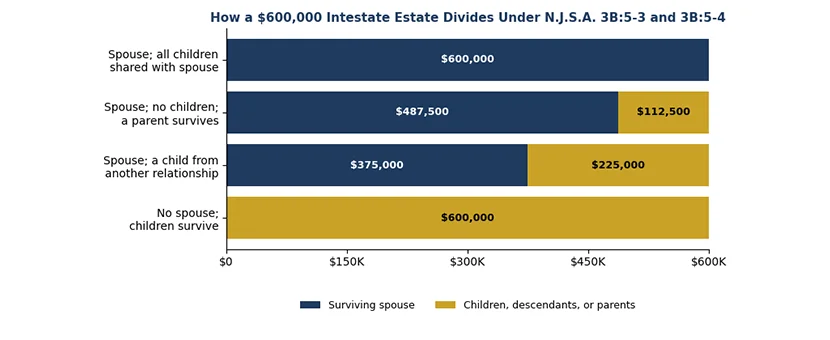
Illustration based on N.J.S.A. 3B:5-3 and 3B:5-4. The first scenario assumes the spouse has no descendants from another relationship.
Blended families feel these rules most sharply. A stepchild generally inherits nothing under intestacy unless no closer relative survives, and a child from a prior relationship can share the estate with a current spouse in a way neither of them expected.
Our role is to confirm who the legal heirs are, document the family tree for the court, and calculate each share correctly before any money leaves the estate account.
Probate and the Bergen County Family Home
For most Bergen County estates, the house is the single largest asset. That makes it the asset most likely to delay probate and the one most likely to divide a family.
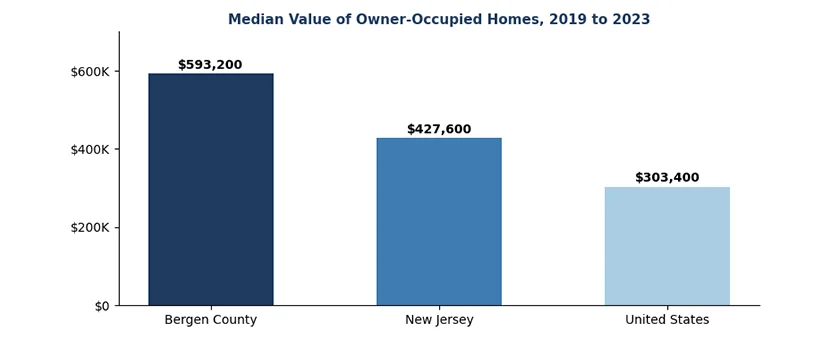
Source: U.S. Census Bureau, QuickFacts, American Community Survey 5-Year Estimates, 2019 to 2023.
A median owner-occupied home value of $593,200 places a typical Bergen County house well above state and national levels. In towns like Ridgewood, Saddle River, and Upper Saddle River, values often run far higher.
With that much value in one asset, several legal questions come up at once. Does the will give the executor a power of sale, or will the heirs need to sign off? Is a tax waiver needed before title can transfer? Does one sibling want to keep the house while the others want to sell?
Our executor duties and responsibilities page covers the executor’s basic obligations around property. As probate counsel, we handle the legal pieces that sit around a sale or transfer: confirming authority to sell, clearing title issues, coordinating the inheritance tax waiver, and drafting buyout terms when one heir keeps the home.
Because Attorney Banks also practices real estate law, the probate side and the closing side are handled by the same office. That removes a handoff that often slows estate sales.
“Real estate is often the most valuable asset in an estate, and inherited property can create conflict among siblings. Planning ahead for who will keep, sell, or manage a home prevents many disputes.” Attorney Patrick V. Banks
Facing a decision about an inherited Bergen County home? Attorney Banks reviews the will, the title, and each heir’s position, then explains your options before anyone signs a listing agreement. Call 201-483-2338 for a free initial consultation.
Bergen County Estates With New York Ties
Bergen County sits across the Hudson River from New York City, and many residents worked, invested, or owned property there. Those connections follow the estate into probate.
New Jersey letters testamentary do not give an executor power over real estate located in New York. A Manhattan co-op, a condo in Westchester, or a lake house upstate usually requires an ancillary proceeding in the New York Surrogate’s Court for the county where the property sits.
Tax exposure can differ as well. New Jersey repealed its estate tax for deaths after 2017, but New York did not.
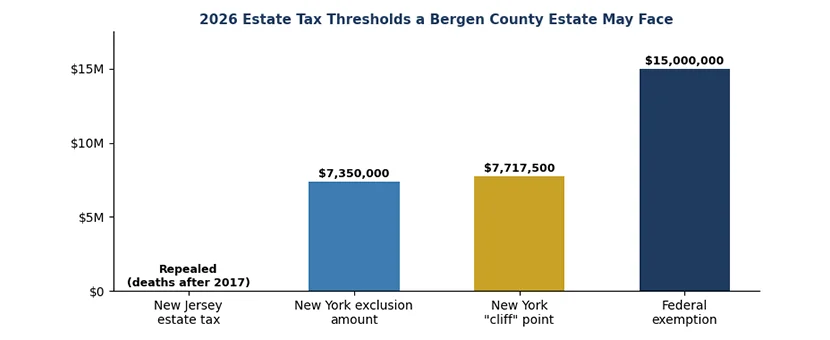
Sources: New York State Department of Taxation and Finance; Internal Revenue Service. Figures apply to deaths in 2026.
A New Jersey resident whose estate includes New York real property may have to file a New York estate tax return if the total gross estate exceeds New York’s exclusion amount, which is $7,350,000 for 2026. New York also applies a cliff: once a taxable estate exceeds 105 percent of the exclusion amount, the exclusion disappears and the whole estate is taxed.
The comparison below shows how the two systems differ for a family settling an estate on both sides of the river.
| Issue | New Jersey (Bergen County) | New York |
|---|---|---|
| Who issues letters | County Surrogate, often at one appointment | County Surrogate’s Court, after a petition is filed |
| Notice to family | Notice of probate mailed after the will is admitted | Citation or signed waivers from distributees, usually before letters issue |
| State estate tax | None for deaths on or after January 1, 2018 | Applies above $7,350,000 in 2026, with a cliff at 105 percent |
| State inheritance tax | Yes, for some beneficiary classes | None |
| Small estate option | Affidavit procedures for modest estates | Voluntary administration for estates up to $50,000 |
We coordinate with New York counsel when ancillary probate is required, so the New Jersey estate and the New York filing stay on the same timeline. New Jersey’s own tax picture, including the inheritance tax, is explained on our New Jersey inheritance tax and estate tax page.
Medicaid Estate Recovery Claims in Bergen County Estates
Many Bergen County families pay for a parent’s long-term care through Medicaid. After that parent dies, the State may seek repayment from the estate.
Under N.J.S.A. 30:4D-7.2, the New Jersey Division of Medical Assistance and Health Services can recover Medicaid benefits paid for services received at age 55 or older. New Jersey uses a broad definition of estate for this purpose, which can reach assets held jointly, through a life estate, or in a living trust, not only assets that pass under a will.
Recovery is postponed while a spouse survives or while there is a surviving child who is under 21, blind, or permanently disabled. The State’s claim also has priority over many ordinary debts.
That combination catches families off guard, especially when the house was the parent’s main asset. We review the claim amount, confirm whether an exemption or deferral applies, and pursue a hardship waiver or compromise when the facts support one.
How Probate Attorney Fees Work in New Jersey
Legal fees for probate work are generally treated as a cost of administering the estate. That means the estate pays them, not the executor out of their own pocket, as long as the work benefits the estate and the fee is reasonable.
New Jersey’s Rules of Professional Conduct require that fees be reasonable and that the basis for the fee be communicated, preferably in writing. Our firm provides a written fee arrangement at the start of every probate engagement.
Some tasks can be quoted at a set price, while others, such as contested hearings, depend on how the matter unfolds. Either way, you will know how billing works before any work begins.
Common Concerns About Hiring a Probate Lawyer
“The Surrogate Said I Did Not Need an Attorney”
For the appointment itself, that is often true. The Surrogate’s staff can process routine paperwork, but they cannot give legal advice about a lost will, a disputed heir, a Medicaid claim, or a New York co-op. Those questions arise after the appointment, when the Surrogate is no longer involved.
“A Lawyer Will Eat Up the Inheritance”
Legal fees are a real cost, and we discuss them openly. Mistakes cost more. An improper distribution, a missed tax filing, or a sale made without proper authority can create personal liability for the executor and expensive litigation for the family.
“My Family Gets Along, So Probate Will Be Simple”
Good relationships help, but they do not change the law. A copy of a will still cannot be probated without court action, and an intestate estate still divides by statute. Starting with clear legal answers often keeps a family cooperative.
Frequently Asked Questions About Probate in Bergen County
What Happens When You Call Patrick Banks Law
When you call 201-483-2338, our office will ask a few basic questions: who passed away, whether you have the original will, and whether you have already been to the Surrogate. The initial consultation is free.
Attorney Banks then speaks with you directly about the estate. You will leave the conversation knowing whether your matter belongs at the Surrogate’s office, in the Probate Part, or in a New York court, and what the next step should be.
Related Estate Administration Services
Probate is one part of our estate administration practice in Bergen County. Families settling a trust rather than a will can learn more about trust administration. When a probate dispute escalates into a challenge to the will itself, our will contests page explains how those cases proceed.
Talk to a Bergen County Probate Attorney Today
Attorney Patrick V. Banks earned his law degree from Seton Hall University School of Law in 2000 and has practiced estate law in Bergen County since 2007. He works with executors, administrators, and heirs in Ridgewood, Upper Saddle River, and towns throughout the county.
Probate stalled or not sure where to start? Call Patrick Banks Law at 201-483-2338 or complete our online questionnaire to schedule your free initial consultation.
