



Patrick Banks Law guides executors, administrators, and family members through estate administration in Bergen County, New Jersey. Attorney Patrick Banks handles probate filings with the Bergen County Surrogate’s Court, advises executors on their legal duties, administers trusts after a loved one passes away, and helps families calculate and pay New Jersey inheritance tax correctly. Most families reach out shortly after a loved one has passed away, often unsure of the first step. A free initial call is the place to start.
Serving as an executor sounds simple until the paperwork starts.
New Jersey requires specific filings with the county Surrogate’s Court. Creditors have to be notified. Executors must locate, value, and protect assets. Taxes have to be calculated and paid, sometimes to two different authorities.
Attorney Banks has guided Bergen County executors through this process since 2007. He also represents clients when administration disputes end up in litigation, which shapes how he advises executors from day one.

That combination matters more than it may seem at first. An attorney who only drafts wills has never seen how a vague clause plays out before a Surrogate. An attorney who only litigates disputes rarely gets the chance to prevent them in the first place.
Why Estate Administration Gets Complicated
Administering an estate means carrying out the instructions in a will, or, if there is no will, following New Jersey’s intestacy statute under court supervision.
The executor named in the will, or the administrator the court appoints, is legally responsible for the entire process. That includes locating assets, paying valid debts, filing tax returns, and eventually distributing what remains to the correct beneficiaries.
Bergen County adds a few local wrinkles. Home values in towns such as Ridgewood and Upper Saddle River are high, so a single piece of real estate can dominate an estate’s value and complicate both accounting and tax calculations.
A high-value home also raises the stakes on getting the date-of-death valuation right, since that figure drives both the New Jersey inheritance tax calculation and the capital gains calculation a beneficiary may face if the property is later sold.
Many estates here also include property in more than one state, a closely held business, or out-of-state beneficiaries who are harder to reach for required notices.
An executor who gets any of this wrong risks more than delay. New Jersey law can hold an executor personally liable for mistakes, including paying beneficiaries before creditors are satisfied or missing a tax filing deadline.
A trust adds its own layer of complexity when one exists alongside, or instead of, a probate estate. The trustee named in that trust has separate duties on a separate timeline, and the two processes sometimes need careful coordination.
Most first-time executors have never handled anything like this before. The role typically falls to a surviving spouse or adult child, often while that same person is also grieving, and the legal responsibilities do not pause for that.
Banks, brokerages, and the Surrogate’s Court itself all expect specific documents in a specific order. An executor who doesn’t know that order in advance often loses weeks figuring out what to do first.
First Steps After a Loved One Passes Away
Families rarely know where to start in the first days after a death, and that is normal.
Obtain multiple certified copies of the death certificate. Banks, insurance companies, and the Surrogate’s Court will each ask for one.
Locate the original will. A copy is usually not enough for probate, and the original is often kept at home, in a safe deposit box, or with the attorney who drafted it.
Secure the deceased person’s property, including the home, vehicles, and any valuables, and notify the homeowner’s insurance carrier that the property is temporarily unoccupied, if applicable.
Avoid paying bills or distributing any property before speaking with an attorney. Well-meaning family members sometimes pay a bill or hand over a keepsake early, and it can complicate the accounting later.
Contact an estate administration attorney before filing anything with the Surrogate’s Court. Getting the initial filing right avoids delays that are difficult to unwind later.
The New Jersey Probate Process
Probate is the court-supervised process of validating a will, appointing an executor, and overseeing estate administration.
In New Jersey, this happens at the county level, through the Surrogate’s Court. The diagram below walks through the general sequence for a typical Bergen County estate.
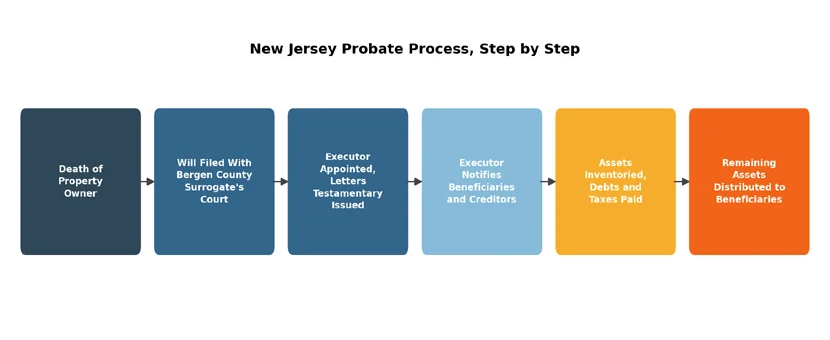
General sequence for an uncontested New Jersey probate matter. Individual estates may vary.
Filing the Will
The original will, along with a certified death certificate, is filed with the Bergen County Surrogate’s Court.
The person named as executor in the will typically handles this filing and, once approved, receives letters testamentary. That document is what allows the executor to act on the estate’s behalf with banks, brokerages, and other institutions.
Administration Without a Will
If a person dies without a will, the Surrogate’s Court appoints an administrator instead of an executor, usually a close family member.
That administrator follows New Jersey’s intestacy statute rather than the deceased person’s own instructions, since none exist. The process otherwise looks similar to standard probate, just without a will to guide distribution.
Ancillary Probate for Out of State Property
A Bergen County resident who owned a vacation home or other real estate in another state may require a second, ancillary probate proceeding in that state.
New Jersey’s probate order does not automatically transfer title to out of state real estate. Attorney Banks coordinates with local counsel in the other state when this applies.
Executor Duties and Responsibilities
An executor’s legal duties in New Jersey break down into several distinct phases.
Locating and securing assets comes first. This includes bank and investment accounts, real estate, vehicles, and personal property, along with any life insurance or retirement accounts that name the estate rather than an individual as beneficiary.
Notifying beneficiaries and creditors comes next. New Jersey law requires formal notice within a set period after appointment, and this notice starts the clock on the window creditors have to submit claims.
Paying valid debts and taxes follows. This includes ordinary debts, final medical and funeral expenses, any New Jersey inheritance tax owed, and federal estate tax if the estate is large enough to trigger it.
Accounting to beneficiaries comes before final distribution. An executor typically prepares a formal accounting showing every asset, expense, and distribution, which beneficiaries have the right to review and, if necessary, challenge in court.
Final distribution closes out the estate. Once debts, taxes, and expenses are paid and any accounting disputes are resolved, remaining assets are distributed according to the will or, absent a will, according to New Jersey’s intestacy statute.
An executor is entitled to a statutory commission for this work, calculated as a percentage of the estate under New Jersey law, in addition to reimbursement for reasonable expenses.
Handling Real Estate During Administration
Real estate is often the single largest asset in a Bergen County estate, and it needs active management during administration, not just an eventual sale or transfer.
An executor is responsible for maintaining the property, keeping insurance in place, and paying the mortgage, taxes, and utilities until the estate closes.
If the will directs a sale, the executor arranges that sale under Surrogate’s Court rules. If the property passes directly to a beneficiary, the executor still has to clear title and record the transfer correctly.
A property in another state adds the ancillary probate step described above, and a property still carrying a mortgage may require coordination with the lender before any transfer.


When an Estate Includes a Business
A closely held business complicates administration in ways a simple estate does not.
The executor must determine whether the business continues operating during administration, whether a professional needs to value it, and whether a buy-sell or partnership agreement already dictates what happens to the deceased owner’s share.
Employees, customers, and business partners often need clarity quickly, well before the estate itself is fully settled. Attorney Banks works directly with a family’s accountant and any surviving business partners to keep the business stable while the broader estate moves through administration.
Executor Compensation in New Jersey
New Jersey law entitles an executor to a statutory commission, calculated as a percentage of the estate’s value, along with a separate commission on income the estate earns during administration.
An executor is also entitled to reimbursement for reasonable out-of-pocket expenses, such as filing fees, appraisal costs, or travel required to manage estate property.
Some family member executors choose to waive their commission, particularly when they are also the primary beneficiary, but this is a personal choice, not a legal requirement.
Digital Assets During Administration
Modern estates almost always include digital property, and an executor must account for it like any other asset.
Online bank and brokerage accounts, cryptocurrency holdings, and even accumulated points or credits can carry real financial value. Email and social media accounts, while not financial assets, often need to be closed or memorialized when winding down the estate.
Without a password manager or written instructions from the deceased, an executor may need to work directly with each company’s estate or deceased-user policy, which varies widely and can take considerable time.
Administering a Distribution to a Beneficiary on Government Benefits
An executor who is not careful can accidentally disqualify a beneficiary from Supplemental Security Income or Medicaid simply by distributing an inheritance directly.
If the estate plan included a special needs trust for that beneficiary, the executor distributes that beneficiary’s share into the trust rather than to the beneficiary personally.
If no such trust exists and the executor learns a beneficiary is eligible for benefits, discuss it with an attorney before any distribution, since correcting a mistake after the fact is far harder than avoiding it.
Trust Administration
Not every estate goes through probate. Assets held in a properly funded revocable living trust bypass the Surrogate’s Court entirely and are instead administered directly by the trustee.
Trust administration still carries real legal obligations. A trustee must inventory trust assets, pay the trust’s debts and taxes, keep accurate records, communicate with beneficiaries, and distribute assets according to the trust’s specific terms.
For an irrevocable trust, including a dynasty trust or an education trust set up during the original estate plan, the trustee’s duties continue for as long as the trust holds assets, sometimes across multiple generations.
Attorney Banks advises both family member trustees and professional fiduciaries on these ongoing obligations, and steps in directly when a trustee’s decisions are challenged by a beneficiary.
A revocable trust that was never fully funded during the grantor’s lifetime creates a particular headache during administration. Any asset left outside the trust still has to go through probate regardless of what the trust document says, which often surprises families who assumed the trust covered everything.
When Beneficiaries Disagree
Disagreements among beneficiaries are one of the most common sources of delay and expense in estate administration.
A disagreement might involve the value assigned to a piece of property, the timing of a distribution, or a belief that the executor is favoring one beneficiary over another.
An executor who keeps detailed records, communicates proactively, and follows the will’s instructions precisely is in the strongest position if a disagreement does arise. Attorney Banks advises executors on documentation practices specifically designed to hold up if a beneficiary later challenges a decision.
Trustee Duties in Detail
A trustee’s duties mirror an executor’s in structure, even though the trustee answers to the trust document rather than to the Surrogate’s Court.
Inventorying and safeguarding trust assets comes first, followed by ongoing management, which can include investing trust funds prudently for years or decades if the trust is designed to last that long.
Paying the trust’s own tax obligations follows, since a trust that earns income during administration generally files its own fiduciary income tax return, separate from any individual beneficiary’s personal return.
Making distributions according to the trust’s specific terms comes last, and for a dynasty trust or an education trust, this duty can continue across multiple beneficiaries and multiple generations rather than concluding after a single distribution.
A trustee who fails in any of these duties can be removed and held personally liable for losses the trust suffers as a result, much like an executor can be held liable during probate.
How Estate Administration Differs From Estate Litigation
Administration and litigation are related but distinct, and understanding the difference matters for knowing what kind of help to look for.
Administration is the day-to-day process of settling an estate or trust when everyone generally agrees on the plan, even if the paperwork is complex. It moves through the Surrogate’s Court’s administrative process.
Litigation begins when someone disputes part of that process, whether the will’s validity, an executor’s conduct, or a trustee’s decisions. Disputed matters move out of the Surrogate’s administrative track and into the Superior Court’s Probate Part.
Attorney Banks handles both, so an administration matter that becomes contested does not require finding a new attorney partway through.
Serving as Executor Yourself or Hiring a Professional Fiduciary
Most Bergen County families default to naming a spouse or adult child as executor, and that choice works well in many estates.
A professional fiduciary, such as a bank trust department or an attorney, is worth considering when the estate includes a business, significant out-of-state property, a beneficiary who receives government benefits, or family members who are unlikely to agree on major decisions.
A professional fiduciary charges a fee for this service, generally in line with the same statutory commission structure a family member executor is entitled to, but brings experience with the deadlines and filings that a first-time family executor does not have.
Probate Administration Compared to Trust Administration
Families are often surprised to learn that an estate can involve both processes at once, each with its own rules and its own timeline.
| Feature | Probate Administration | Trust Administration |
|---|---|---|
| Court Involvement | Supervised by the Bergen County Surrogate’s Court | No court involvement unless a dispute arises |
| Becomes Public Record | Yes, once the will is filed | No, trust terms generally stay private |
| Who Oversees It | Executor named in the will, or a court appointed administrator | Trustee named in the trust document |
| Governed By | New Jersey probate code and the will’s terms | The trust document itself and New Jersey trust law |
Estate Administration for Blended Families
Administration often surfaces tension in a blended family that estate planning did not fully resolve, or that no plan addressed.
A surviving spouse and adult stepchildren from a first marriage frequently have different expectations about the family home, personal property with sentimental value, or the timing of distributions.
An executor caught in the middle of this dynamic benefits from clear documentation and, often, from an attorney who can communicate directly with beneficiaries on the executor’s behalf rather than leaving the executor to manage family tension alone.
Attorney Banks has represented executors, surviving spouses, and adult children on different sides of exactly this kind of Bergen County dispute, which shapes the practical guidance he gives at the start of administration.
The Cost of Estate Administration in Bergen County
Every estate involves some combination of court filing fees, an executor’s statutory commission, and, in most cases, attorney fees for guidance through the process.
New Jersey sets the executor’s commission by statute as a percentage of the estate’s value, so this cost is predictable, not negotiated.
Attorney fees for estate administration vary with the estate’s complexity. A straightforward, uncontested estate with a small number of assets costs considerably less to administer than one involving a business, out-of-state property, or a contested accounting.
Court filing fees with the Bergen County Surrogate’s Court are generally modest compared to other costs, though additional fees can apply for certified copies of letters testamentary, which banks and other institutions often require more than one of.
Attorney Banks provides an exact fee structure after reviewing the specific estate, so an executor knows the expected cost before deciding how to proceed.
Estate Administration Timeline in Bergen County
Families often ask how long administering an estate actually takes. The honest answer is that it depends on the estate, but the chart below shows the general phases for a typical, uncontested Bergen County estate.
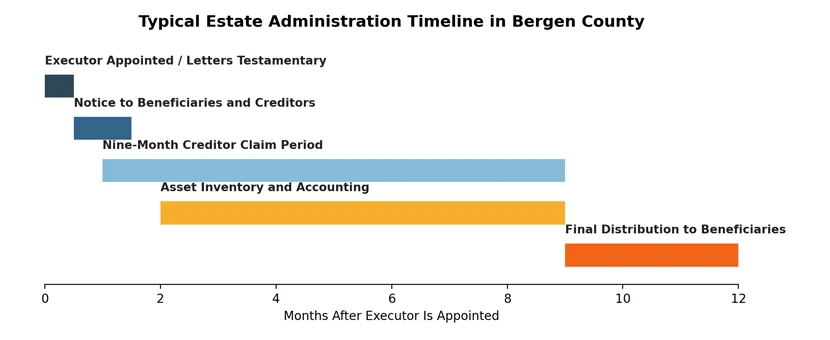
Typical phases of estate administration for an uncontested New Jersey estate. Contested matters take longer.
The nine month period shown above reflects New Jersey’s statutory window for creditors to present claims against an estate. Final distribution before that window closes can expose an executor to personal liability if a valid claim later surfaces.
Estate and Inheritance Tax During Administration
Paying the correct tax is one of an executor’s most important, and most commonly mismanaged, responsibilities.
New Jersey no longer imposes a state estate tax on anyone who died on or after January 1, 2018. Estates of individuals who died earlier may still owe New Jersey estate tax, depending on the date of death and the estate’s size.
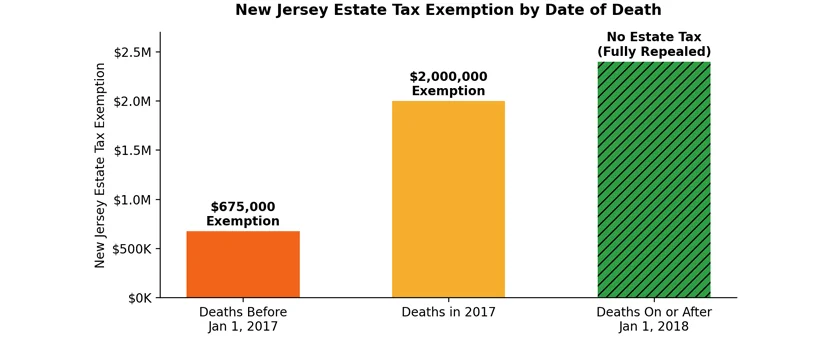
New Jersey estate tax exemption by date of death. Source: P.L. 2016, Ch. 57.
New Jersey’s separate inheritance tax remains fully in effect regardless of when the death occurred. It applies based on the relationship between the deceased person and each individual beneficiary, not on the size of the estate as a whole.
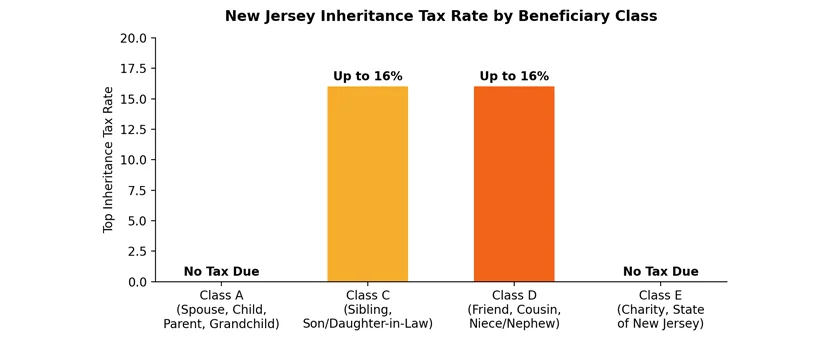
Top New Jersey inheritance tax rate by beneficiary class.
| Beneficiary Class | Who Is Included | Tax Rate |
|---|---|---|
| Class A | Spouse, civil union/domestic partner, child, stepchild, grandchild, parent, grandparent | No tax due |
| Class C | Sibling, son-in-law, daughter-in-law | First $25,000 exempt; 11% to 16% above that, up to $1,700,000 |
| Class D | Niece, nephew, cousin, friend, any other unrelated beneficiary | 15% up to $700,000; 16% above $700,000 |
| Class E | State of New Jersey, its subdivisions, and most 501(c)(3) charities | Fully exempt |
Source: New Jersey Division of Taxation, Inheritance Tax Rates.
The New Jersey inheritance tax return is due within eight months of the date of death, and an executor who distributes assets before the return is filed and any tax is paid can become personally responsible for the shortfall.
Estate Administration and the Bergen County Surrogate’s Court
Bergen County residents file probate matters with the Bergen County Surrogate’s Court, located at Two Bergen County Plaza, Fifth Floor, Suite 5000, Hackensack, New Jersey 07601, reachable at 201-336-6700.
The Bergen County Surrogate, currently Michael R. Dressler, oversees uncontested probate matters, including the appointment of executors and administrators, and the review of estate accountings.
Uncontested matters are typically handled efficiently at this administrative level. Once a will’s validity is challenged, or an executor’s conduct is disputed, the matter moves out of the Surrogate’s administrative process and into the Superior Court’s Probate Part.
Attorney Banks has represented clients on both sides of that kind of dispute in Bergen County, which informs the guidance he gives executors before a disagreement escalates that far.
Tax Returns an Executor Must File
Estate administration typically involves more than one tax filing, and each has its own deadline.
The deceased person’s final federal and New Jersey personal income tax returns cover the period from the start of the year through the date of death, and are generally due on the normal filing deadline for that tax year.
If the estate itself earns income during administration, such as interest, dividends, or rental income, it may need to file its own federal fiduciary income tax return, along with a corresponding New Jersey filing.
The New Jersey inheritance tax return, covering any tax owed by individual beneficiaries, is generally due within eight months of the date of death, regardless of when assets are actually distributed.
Missing any of these deadlines can result in penalties and interest charged against the estate, which reduces what ultimately reaches the beneficiaries.
Common Estate Administration Mistakes
Attorney Banks sees the same handful of executor mistakes repeatedly.
Distributing assets too early is the most costly. An executor who pays beneficiaries before the nine month creditor window closes, or before the inheritance tax return is filed, can be held personally liable if a valid claim or tax bill surfaces afterward.
Mixing estate funds with personal funds is a close second. An executor should open a dedicated estate account and keep every transaction separate and documented.
Failing to keep a formal accounting causes problems later, even when every decision the executor made was reasonable. Beneficiaries are entitled to a clear record, and disputes often start with a beneficiary who simply does not know what happened to the assets.
Overlooking ancillary probate for out of state property leaves title unresolved on a home or account the family may not realize needs a separate proceeding.
Missing the inheritance tax filing deadline is common simply because executors do not realize the eight month window exists until it has nearly passed.
Skipping a date of death valuation on real estate or investment accounts creates problems later, since both the inheritance tax calculation and any future sale of inherited property depend on an accurate value as of that specific date.
Forgetting the deceased person’s final income tax return is easy to overlook amid everything else, but it remains due on the normal schedule regardless of the death.
When an Estate Cannot Cover Its Debts
An estate is insolvent when its debts exceed the value of its assets, and New Jersey law sets a specific priority order for paying what the estate does have.
Funeral and administration expenses generally come first, followed by certain family allowances, then secured debts, and finally general unsecured creditors, with beneficiaries receiving whatever remains only after every category above them is satisfied.
An executor who pays creditors out of this order, even unintentionally, can be held personally responsible for the difference. Insolvent estates are one of the clearest situations where hiring an attorney before making any payments protects the executor directly.
Beneficiaries of an insolvent estate should also understand that they may receive nothing, through no fault of the executor, if debts genuinely exceed the estate’s value.
Signs You Need an Estate Administration Attorney
Not every small estate requires an attorney at every step, but certain situations call for guidance immediately.
A beneficiary is disputing the will, the executor’s conduct, or the accounting. A family member has already hired an attorney of their own. The estate includes a business, out of state property, or assets that are difficult to value.
The estate may be insolvent, meaning debts could exceed assets. The executor is unsure how to calculate or file New Jersey inheritance tax. Or the executor simply feels overwhelmed by the volume of paperwork and deadlines involved.
The estate includes a beneficiary who receives government benefits, which raises the special distribution concerns described above. Multiple executors have been named and disagree on how to proceed. Or a deadline has already passed and the executor is unsure what happens next.
Any of these situations is a reasonable reason to bring in an attorney rather than proceed alone.
If You Are Already Facing a Dispute
Some families reach out after administration has already gone wrong, not before.
A sibling may be contesting the accounting. An executor may be accused of mismanaging assets. A beneficiary may feel left in the dark about the process entirely.
Attorney Banks has represented clients on both sides of exactly these disputes in Bergen County’s Surrogate’s Court and Superior Court.
Getting an attorney involved early, before positions harden and legal fees accumulate on both sides, generally leads to a faster and less expensive resolution than waiting until the dispute is fully underway.
This holds true whether you are the executor trying to keep the estate on track or a beneficiary who feels shut out of a process you have every right to understand.
Call 201-483-2338 to discuss where things stand, or complete the online questionnaire to begin on your own schedule.
