


A Bergen County will contest attorney helps you decide whether to challenge a will, then files and argues that challenge in the Superior Court, Probate Part, in Hackensack. Strict deadlines apply, and a contest is not always the best tool.
Some disinherited spouses, later-born children, and beneficiaries have stronger remedies outside a contest. Patrick Banks Law reviews your facts and tells you which path fits.
Learning that a parent’s will leaves you far less than you expected is painful. Finding out that a sibling or caregiver received nearly everything can feel worse.
Attorney Patrick V. Banks has handled contested estates in Bergen County since 2007, representing both family members who challenge wills and executors who defend them. This page focuses on the will contest itself: whether it is the right move, what it can realistically change, and what happens once a caveat is filed.

For the full range of estate disputes, including accountings and fiduciary removal, see our Bergen County estate litigation page.
Is a Will Contest the Right Tool for Your Situation?
A will contest asks a court to declare a will invalid. That is a serious request, and it is not the only way to correct an unfair result.
In several common situations, New Jersey law offers a more direct remedy that does not require proving anything was wrong with the will at all. Choosing the right claim early can save months and a great deal of expense.
| Your Situation | Better Fit Than a Contest? | What That Remedy Requires |
|---|---|---|
| You are the surviving spouse and were left little or nothing | Often, yes: an elective share claim | Living together at the time of death, and a timely filing |
| You were born or adopted after the will was signed | Often, yes: a pretermitted child claim | No sign the omission was intentional |
| The executor is mishandling a valid will | Yes: a fiduciary claim | Proof of a specific breach of duty |
| Most assets passed by beneficiary designation or joint title | A will contest may not reach them | A separate challenge to the transfer itself |
| The will itself was forged, improperly signed, or the product of pressure | No: a will contest is the right claim | Standing and a filing within the deadline |
Surviving Spouses and the Elective Share
A spouse or domestic partner who is disinherited does not need to prove the will is invalid. Under N.J.S.A. 3B:8-1, a surviving spouse may generally elect to take one-third of the augmented estate instead of what the will provides.
The right is not automatic. It applies only if the couple had not been living separate and apart under circumstances that would have supported a divorce, and the claim must be filed within six months after a personal representative is appointed.
The augmented estate can include certain assets transferred outside the will, which is why this claim often reaches more than a contest would.
Children Born or Adopted After the Will
New Jersey does not require a parent to leave anything to an adult child. A child left out of a will usually has no claim on that basis alone.
A child born or adopted after the will was signed is treated differently. Under N.J.S.A. 3B:5-15, that child can often receive the share they would have inherited without a will, unless the will shows the omission was intentional or the parent provided for the child in another way.
Assets That Pass Outside the Will
Even a successful will contest only controls assets that pass under the will. Life insurance, retirement accounts, payable-on-death accounts, and jointly titled property usually transfer by contract or title instead.
If a parent changed a beneficiary designation shortly before death, you must challenge that change separately. We look at the full asset picture before recommending any strategy.
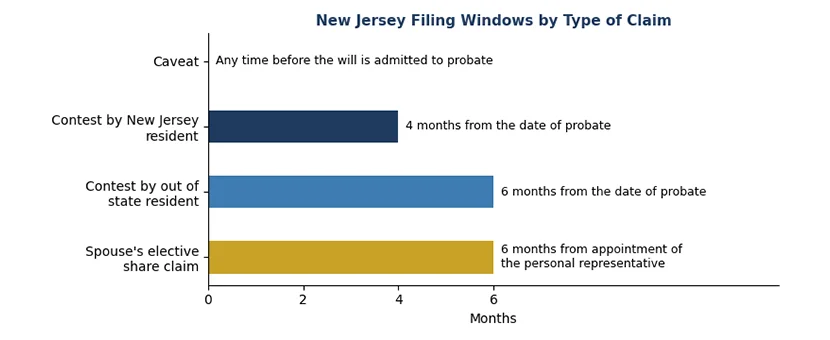
General filing windows under New Jersey Court Rule 4:85-1 and N.J.S.A. 3B:8-12. Specific facts can change how a deadline applies.
What a Successful Will Contest Actually Changes
A court that rejects a will does not rewrite it to be fair. The estate passes under whatever document, or statute, comes next in line.
If an earlier valid will exists, that will usually controls. If there is no earlier will, the estate passes under New Jersey’s intestacy statute, as if no will had ever been signed.
That distinction matters before you file. A contest is worth pursuing only if the result that replaces the challenged will actually improves your position.
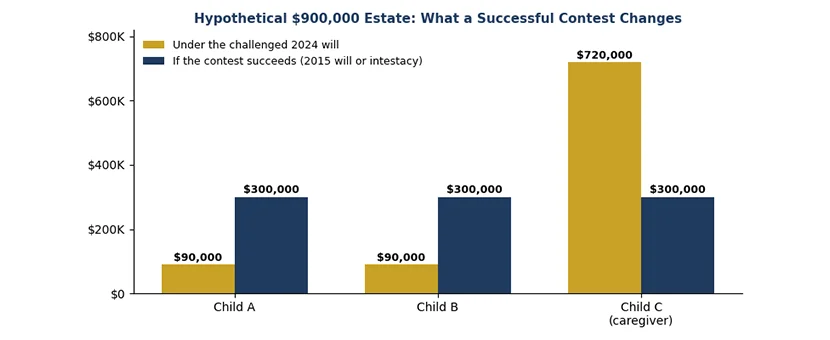
Hypothetical example for illustration only. Assumes no surviving spouse and an earlier will dividing the estate equally among three children.
In the example above, Child A stands to gain $210,000 if the contest succeeds. If the earlier will had also favored Child C, the same contest could gain Child A nothing.
Courts can also set aside only part of a will. When pressure or a mistake affected a single gift, a judge may strike that gift and leave the rest of the document in place. A codicil, which amends a will, can be challenged separately from the will it changes.
We run these numbers with every client before recommending a contest, so the decision rests on what you could realistically receive.
What Happens After a Caveat Is Filed in Bergen County
A caveat is a written objection filed with the Bergen County Surrogate before a will is admitted to probate. Our estate litigation page explains when to file one and the risks a no-contest clause can create.
Many families are less sure what comes after the caveat. The short answer is that the burden moves to the person who wants the will admitted.
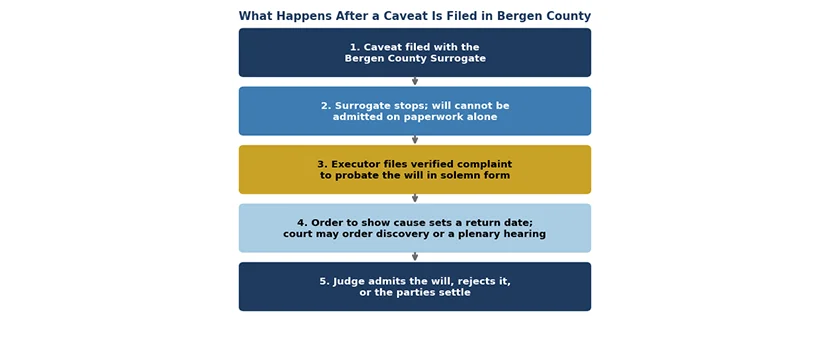
General sequence in the Superior Court, Chancery Division, Probate Part, Bergen Vicinage. Individual cases vary.
Once a caveat is on file, the Surrogate cannot admit the will. The executor named in the will, or another person offering it, must file a verified complaint in the Superior Court asking a judge to admit the will in what is called solemn form.
Probate Part cases generally proceed as summary actions under Court Rules 4:83 and 4:67. The court issues an order to show cause, all interested parties receive notice, and the judge sets a return date.
Summary does not always mean fast. When the facts are disputed, the judge can permit discovery, including depositions and record subpoenas, and schedule a plenary hearing where witnesses testify.
While the case is pending, someone still has to protect the estate. The court can appoint a temporary administrator, sometimes called an administrator pendente lite, to pay bills, maintain property, and preserve assets until the dispute is resolved.
Defending a Will as the Named Executor
Executors are often caught off guard by a caveat or contest. Defending a valid will is part of the job, and you do not have to do it alone.
A self-proving affidavit signed with the will, under N.J.S.A. 3B:3-4, helps a great deal. It allows the court to presume the will was properly signed and witnessed, so the contestant must come forward with evidence to overcome that presumption.
Early steps for an executor include securing the original will and the drafting attorney’s file, identifying witnesses to the signing, and keeping a careful record of every estate expense. An executor who stays neutral and organized is far more credible to a judge.
The table below shows how responsibilities typically divide between the two sides.
| Stage | Contestant (Challenging the Will) | Executor (Defending the Will) |
|---|---|---|
| Before probate | Files a caveat with the Surrogate | Locates the original will and signing witnesses |
| Starting the case | Responds to the verified complaint with objections | Files a verified complaint to probate in solemn form |
| Evidence | Gathers proof of the specific ground claimed | Preserves the drafting file and self-proving affidavit |
| During the case | May seek a temporary administrator | Continues protecting estate assets, if authorized |
| Resolution | Accepts settlement or proceeds to hearing | Seeks admission of the will and approval of fees |
When the challenge involves how the executor is running the estate rather than the will’s validity, a different set of rules applies, which our breach of fiduciary duty page covers.
Why Will Contests Arise in Bergen County Families
Most will contests in New Jersey trace back to the final years of the person’s life. Declining health and changing care arrangements create exactly the conditions that lead to disputes.
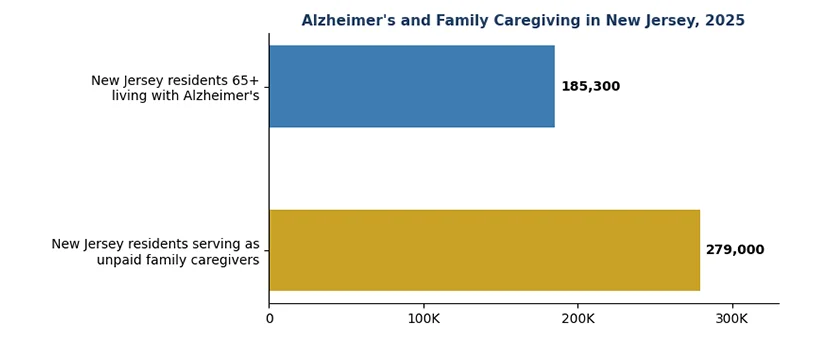
Source: Alzheimer’s Association, 2025 Alzheimer’s Disease Facts and Figures, New Jersey statistics.
More than 185,000 New Jersey residents age 65 and older live with Alzheimer’s disease, and 279,000 New Jersey residents serve as unpaid family caregivers. In Bergen County, those caregivers are often an adult child who lives nearby or moved back home.
When that caregiver later receives a much larger share than siblings, two questions usually follow. Did the parent understand what they were signing, and did the caregiver’s role cross the line into pressure?
Those questions form the basis of separate claims, each with its own legal test. Our pages on lack of testamentary capacity and undue influence claims explain how each one works.
Second marriages create another common pattern. A new spouse named as the main beneficiary, combined with children from a first marriage who expected to inherit, frequently leads to a contest, an elective share claim, or both.
“Will contests often come down to capacity and undue influence. Medical records, witness accounts, and the circumstances around the signing usually tell the story.” Attorney Patrick V. Banks
Wondering whether the facts support a challenge? Attorney Banks reviews the will, any earlier wills, and the timeline around the signing, then gives you a straight answer about your options. Call 201-483-2338 for a free initial consultation.
Wills Signed Outside New Jersey or by Residents Who Moved Away
Many Bergen County residents sign a will in one state and die in another. Some retire to Florida or the Carolinas, while others move here from New York and never update their documents.
Under N.J.S.A. 3B:3-26, New Jersey generally accepts a written will if it was signed in a way that complied with New Jersey law, the law of the place where it was signed, or the law of the place where the person lived at signing or at death. A will signed correctly in another state usually is not invalid here just because the formalities differed.
The bigger question is often where the contest belongs. A will is probated in the state where the person was domiciled at death. If a parent moved to Florida and lived there full time, the main contest generally happens in a Florida court, even if the family and the house remain in Bergen County.


Domicile itself can be disputed. Voter registration, tax filings, driver’s licenses, and where the person actually spent their time all become evidence. Getting this question right first prevents a family from fighting in the wrong courthouse.
Mistakes That Can Weaken a Will Contest
Strong claims are sometimes lost because of choices made in the first few weeks. These are the ones we see most often.
Waiting to see what the executor does is the most costly. The contest deadline runs from the date the will was admitted to probate, whether or not you knew it had happened.
Signing a refunding bond and release, or accepting a distribution, before getting advice can make a later challenge much harder. Read anything the executor sends before you sign it.
Removing items from the house, confronting the caregiver, or posting about the dispute online can create evidence that can be used against you. Let the legal process gather the facts.
Finally, assuming an earlier will will automatically take over can backfire. If that earlier document cannot be found, or it favors the same person, the outcome may look very different than expected.
Common Concerns About Contesting a Will
“A Lawyer Drafted the Will, So It Must Be Valid”
Professional drafting helps prove the will was signed correctly. It does not answer whether the person had capacity that day or whether someone else steered the result. The drafting attorney’s notes often become key evidence for either side.
“I Live Out of State and Cannot Come to Hackensack”
Out-of-state heirs receive a longer six-month window to file, and much of the case can proceed through counsel and written filings. We handle the Bergen County appearances and keep you informed at each step.
“I Already Went to the Surrogate and Signed Some Papers”
That does not automatically end your rights. What you signed, and when, matters a great deal, so bring every document to the consultation.
Frequently Asked Questions About Will Contests in New Jersey
What Happens When You Call Patrick Banks Law
When you call 201-483-2338, we will ask when your loved one died, whether the will has already been probated, and whether you have a copy of it or any earlier wills. Those three answers tell us which deadlines may already be running.
Attorney Banks then reviews your situation with you at no charge. You will come away knowing whether a contest, an elective share claim, or another remedy fits your facts, and roughly what pursuing it would involve.
Related Estate Litigation Services
Will contests are one part of our broader estate litigation practice in Bergen County. When the dispute involves a living trust rather than a will, our page on trust litigation and disputes applies. If the will is ultimately admitted, our guide to the New Jersey probate process explains what comes next.
Speak With a Bergen County Will Contest Attorney
Attorney Patrick V. Banks graduated from Seton Hall University School of Law in 2000 and has represented Bergen County families in estate matters since 2007. Because he also drafts wills and trusts, he knows how these documents are built and where they tend to break down under challenge.
Deadlines may already be running. Call Patrick Banks Law at 201-483-2338 or complete our online questionnaire to schedule your free initial consultation.
