


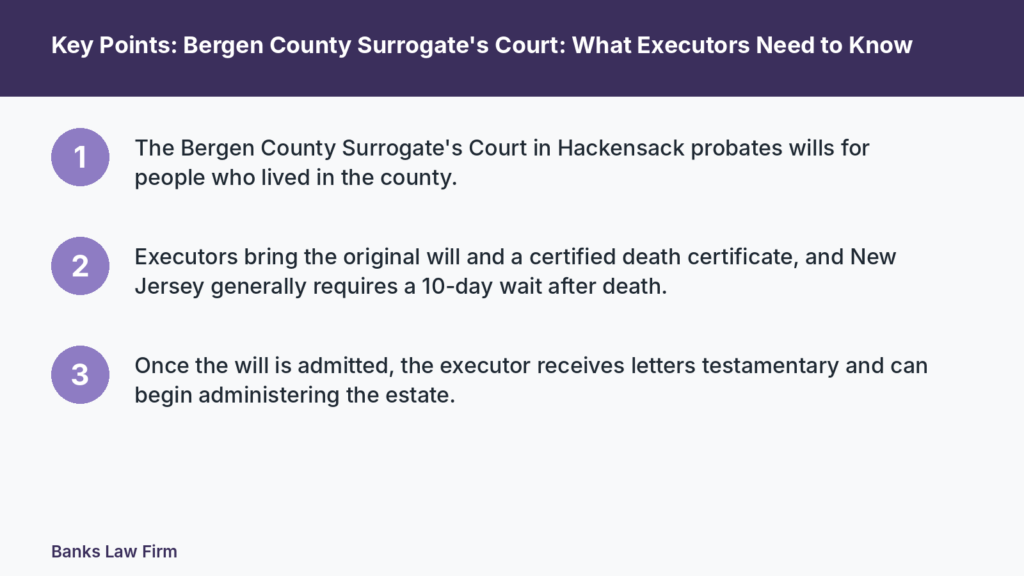
The Bergen County Surrogate’s Court in Hackensack probates wills for people who lived in the county. Executors bring the original will and a certified death certificate, and New Jersey generally requires a 10-day wait after death. Once the will is admitted, the executor receives letters testamentary and can begin administering the estate.
Reviewed by Patrick V. Banks, attorney at Banks Law Firm. Last reviewed November 2026.
The Bergen County Surrogate’s Court handles probate for people who lived in Bergen County when they died. An executor named in a will brings the original will and a certified death certificate to the Surrogate’s office in Hackensack, where the will can be admitted to probate, and the executor can receive letters testamentary. New Jersey generally requires a 10-day wait after death before a will can be probated.
Executors in Ridgewood, Paramus, Teaneck, Fort Lee, and the rest of the county often feel overwhelmed in the first weeks after a death. Knowing what the Surrogate’s Court does, and what it does not do, makes the process easier.
What the Surrogate’s Court Does
| Task | What It Means for Executors |
|---|---|
| Probating wills | Admits the will and confirms it is the decedent’s last valid will |
| Issuing letters testamentary | Gives the executor legal authority to act for the estate |
| Appointing administrators | Handles estates where there is no will |
| Issuing short certificates | Provides official proof of authority for banks and other institutions |
| Guardianships and minors’ funds | Handles certain matters involving children and incapacitated adults |
What to Bring
- The original will and any codicils
- A certified copy of the death certificate
- Your photo identification
- Names and addresses of the decedent’s heirs and beneficiaries
- An estimate of the value of the estate
- Payment for the filing fees
Copies of a will are generally not enough. If the original cannot be found, probate becomes more complicated and may require a court proceeding.
The 10-Day Waiting Period
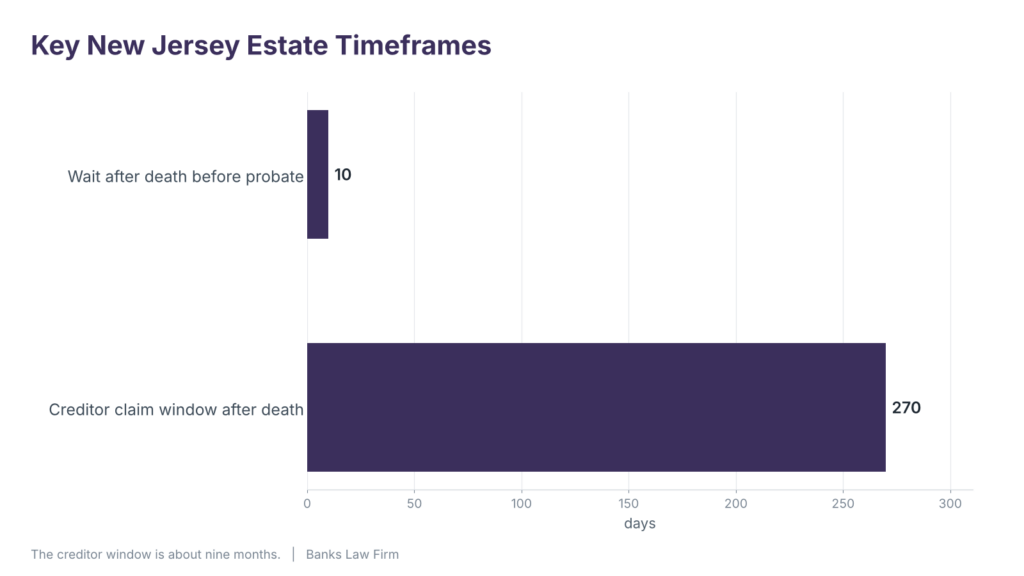
New Jersey generally does not allow a will to be probated until 10 days after the date of death.
That short delay gives family members time to locate the original will and raise any concerns before it is admitted. Executors can use the time to gather documents and list assets and accounts.
Letters Testamentary and Short Certificates
Once the will is admitted, the Surrogate issues letters testamentary to the executor.
Executors usually order several short certificates, which are certified proof of their authority. Banks, brokerage firms, and other institutions generally require one before releasing information or assets.
What Happens After Probate
Probate at the Surrogate’s office is only the beginning. The executor still has to collect assets, pay debts and expenses, handle taxes, and distribute property to beneficiaries.
- Open an estate bank account
- Notify beneficiaries that the will was probated, as New Jersey requires
- Identify and secure estate assets
- Pay valid debts and final expenses
- File required tax returns, including New Jersey inheritance tax when it applies
- Keep careful records and prepare an accounting
- Distribute assets once obligations are met
When the Surrogate Cannot Help
Surrogate’s office staff can explain filing procedures, but they cannot give legal advice.
If there is a will dispute, a missing original, unclear language, or a disagreement among family members, the matter may need to go before a judge in the Superior Court, Chancery Division, Probate Part.
Estates Without a Will
When someone dies without a will, an heir can apply to the Surrogate to be appointed administrator.
Other heirs generally must consent or renounce their right to serve, and the administrator may need to post a bond.
How Long Estate Administration Takes
A simple Bergen County estate with clear assets and no disputes may wrap up in several months.
Estates that owe New Jersey inheritance tax, include real estate, or involve family disagreements often take a year or longer. Creditors generally have nine months from the date of death to present claims, so many executors wait until that period passes before making final distributions.
Common Executor Mistakes
- Distributing assets before debts and taxes are addressed
- Mixing estate money with personal funds
- Missing the beneficiary notice requirement
- Overlooking inheritance tax waivers needed to release certain assets
- Failing to keep records of every transaction
Forms, Fees, and Renunciations
The Surrogate’s office publishes the forms executors and administrators commonly need, along with a schedule of filing fees. Fees generally depend on the size of the estate and the number of pages and certificates requested.
When someone with the right to serve does not want to, they can sign a renunciation. Renunciations are common when several heirs agree that one person should serve as administrator.
Checking the office’s current forms and fee schedule before your appointment can prevent a second trip.
Frequently Asked Questions
Where is the Bergen County Surrogate’s Court?
In Hackensack, the county seat. Check the Surrogate’s office for current hours and appointment procedures.
How long after death can a will be probated in New Jersey?
Generally, 10 days after the date of death.
What are letters testamentary?
Documents from the Surrogate giving the executor authority to act for the estate.
Do I need a lawyer to probate a will in Bergen County?
Not always for the initial filing, but legal help is valuable for administration, taxes, and disputes.
What if there is no will?
An heir can apply to be appointed administrator, usually with the other heirs’ consent.
Is the Surrogate’s Court the same as probate court?
For most estates, yes. The Surrogate handles routine probate, while disputes go to the Superior Court, Chancery Division, Probate Part.
Is there a time limit to probate a will in New Jersey?
There is no short general deadline, but waiting can delay access to assets and create problems with creditors, taxes, and property sales.
Talk to a Bergen County Estate Attorney
Banks Law Firm helps executors and families in Ridgewood and throughout Bergen County with probate, estate administration, and inheritance tax issues.
When you call, our team will ask about the will, the assets, and the family situation, then explain the steps ahead. Visit Banks Law Firm to learn more.
