


A Bergen County family law attorney represents spouses and parents in divorce, child custody, child support, alimony, and prenuptial agreements before the Superior Court, Family Part, in Hackensack. New Jersey law sets specific rules for dividing property and calculating support.
Patrick Banks Law helps Bergen County families resolve these issues while protecting their finances and their children.
Family law cases touch the parts of life that matter most: your children, your home, and your financial security. Decisions made during a divorce or custody case often last for years.

Attorney Patrick V. Banks has represented Bergen County clients since 2007. His practice also covers estate planning and real estate, giving clients one office that understands how a divorce affects the family home, retirement accounts, and the estate plan that follows.
This page explains how family law cases work in Bergen County and what New Jersey law says about the issues families most often face.
Family Law Matters We Handle in Bergen County
Family law covers more than divorce. The table below summarizes the matters our firm handles and the main question each one answers.
| Matter | The Central Question | Where It Is Decided |
|---|---|---|
| Divorce | How the marriage ends and how assets and debts are divided | Family Part, Superior Court |
| Child custody and parenting time | Where children live and how parents share decisions | Family Part, with mandatory mediation |
| Child support | What each parent contributes to the children’s expenses | Guidelines under Court Rule 5:6A |
| Alimony | Whether one spouse pays support to the other, and for how long | Statutory factors, N.J.S.A. 2A:34-23 |
| Prenuptial agreements | How property will be treated if the marriage ends | Contract signed before marriage |
| Post-judgment modifications | Whether a prior order should change | Family Part, on a showing of changed circumstances |
How Divorce Works in Bergen County
Bergen County residents file divorce cases in the Superior Court of New Jersey, Chancery Division, Family Part, at the Bergen County Justice Center at 10 Main Street in Hackensack.
Grounds and Residency
Most New Jersey divorces today are filed on no-fault grounds. Irreconcilable differences require that the differences have lasted at least six months and that there is no reasonable prospect of reconciliation.
Separation is another no-fault ground, but it requires living apart for at least 18 consecutive months. For most grounds, at least one spouse must have been a bona fide New Jersey resident for one year before filing.
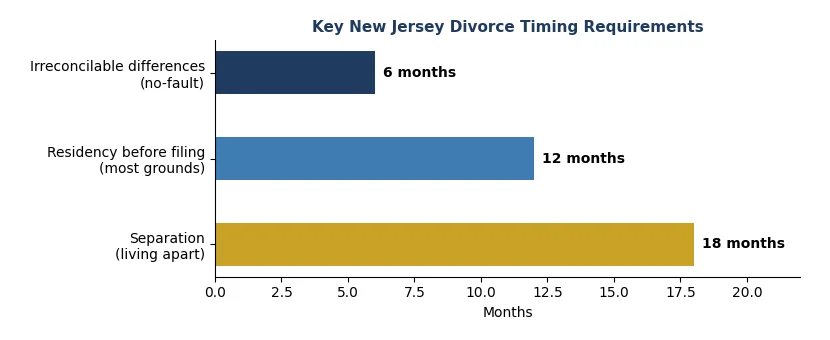
Source: N.J.S.A. 2A:34-2 and 2A:34-10. Residency rules differ for a divorce based on adultery.
The Court Process
Every contested divorce involving property, support, or children moves through several required steps before trial.
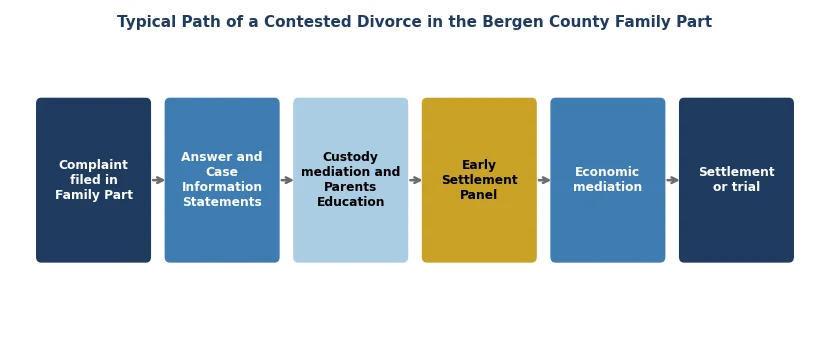
General sequence for a contested divorce. Many cases settle earlier.
Each spouse files a Case Information Statement, a sworn financial disclosure listing income, expenses, assets, and debts. Accuracy here matters, because the court and the other side rely on it throughout the case.
Parents attend a Parents Education Program, and custody disputes go to court-provided mediation. Financial issues are then presented to the Early Settlement Panel, where experienced volunteer attorneys recommend a resolution. If that does not settle the case, the parties attend economic mediation before a trial date is set.
Equitable Distribution of Marital Property
New Jersey divides marital property under the principle of equitable distribution. Equitable means fair under the circumstances, which is not always an even split.
Under N.J.S.A. 2A:34-23.1, the court weighs factors such as the length of the marriage, each spouse’s age and health, income and earning capacity, contributions as a homemaker, and the needs of a parent who will have custody of the children.
| Asset Type | Usually Marital? | Common Issues in Bergen County |
|---|---|---|
| The marital home | Yes, if acquired during the marriage | High values, buyouts, and timing of a sale |
| Retirement accounts and pensions | The portion earned during the marriage | Dividing accounts without tax penalties |
| A business or professional practice | Growth during the marriage | Valuation by a qualified expert |
| Gifts and inheritances | Generally exempt if kept separate | Commingling with joint accounts |
| Property owned before marriage | Generally exempt | Increases in value caused by joint effort |
Inherited property deserves special attention. Under N.J.S.A. 2A:34-23(h), property one spouse received by gift or inheritance from someone other than the other spouse is generally exempt. That protection can be lost when an inheritance is deposited into a joint account or used to pay down the mortgage on a jointly owned home.
“In New Jersey divorces, equitable distribution means a fair division of marital property, not necessarily an equal one. Understanding how the court views each asset is the starting point for any negotiation.” Attorney Patrick V. Banks
Worried about how your assets will be divided? Attorney Banks reviews your property, accounts, and any inheritance you received, then explains how a Bergen County judge is likely to view each one. Call 201-483-2338 for a free initial consultation.
Child Custody and Parenting Time
New Jersey courts decide custody based on the child’s best interests. N.J.S.A. 9:2-4 lists the factors, including each parent’s ability to cooperate, the child’s relationships, the stability of each home, the child’s needs, and the child’s preference when the child is old enough to express one.
Custody has two parts. Legal custody covers major decisions about education, health care, and religion, and joint legal custody is common. Physical custody covers where the child lives day to day and how parenting time is shared.
Parents who agree on a plan can submit it to the court. When they do not, the court requires mediation before a judge decides.
Relocation is a growing issue in Bergen County, where parents may consider moving for work or family. Since 2017, a parent seeking to move a child out of New Jersey over the other parent’s objection must show the move is in the child’s best interests.
“New Jersey courts encourage parents to share in raising their children whenever it is safe and practical. A thoughtful parenting plan focused on the child usually carries the most weight.” Attorney Patrick V. Banks
Child Support in High-Income Bergen County Households
New Jersey calculates child support under the Child Support Guidelines in Court Rule 5:6A. The guidelines combine both parents’ net incomes, find the basic support amount on a statewide schedule, and divide it by each parent’s share of the combined income.
The schedule stops at a combined net income of $187,200 per year. Above that level, the court starts with the highest guidelines amount and then adds support based on the family’s actual circumstances and the factors in N.J.S.A. 2A:34-23(a).
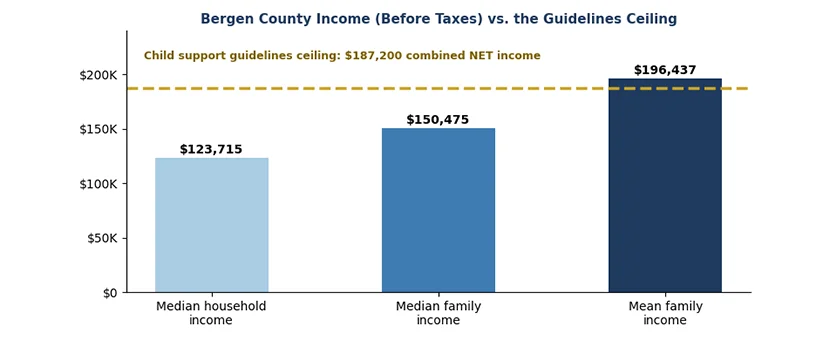
Source: U.S. Census Bureau, American Community Survey 5-Year Estimates, 2019 to 2023, Bergen County. Census figures are gross income; the guidelines ceiling is based on net income after taxes.
Bergen County’s mean family income was $196,437, and the median family income was $150,475. Many two-earner families in the county land near or above the guidelines ceiling, which means support is often argued rather than calculated.
In those cases, documentation of the children’s actual expenses, such as private school, travel sports, camps, and tutoring, carries a great deal of weight. We help clients assemble that record before the support issue is decided.
Alimony in New Jersey
New Jersey courts can award several types of alimony: open durational, limited duration, rehabilitative, and reimbursement. The court considers the statutory factors in N.J.S.A. 2A:34-23(b), including the length of the marriage, each spouse’s earning capacity, the standard of living during the marriage, and the time needed to become self-supporting.
Since 2014, the law has limited alimony in shorter marriages. For a marriage of less than 20 years, the total term of alimony generally cannot exceed the length of the marriage, except in exceptional circumstances.
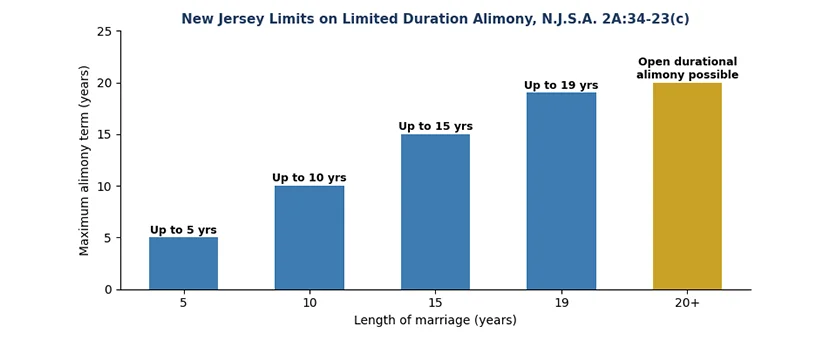
Illustration of the general rule in N.J.S.A. 2A:34-23(c). Courts may award less, and exceptional circumstances can justify a longer term.
Alimony can later be modified when circumstances change substantially, such as a job loss, a good-faith retirement, or the receiving spouse’s cohabitation with a new partner.
Prenuptial Agreements
A prenuptial agreement lets a couple decide in advance how they will handle property and support if the marriage ends. In New Jersey, these agreements are governed by the Uniform Premarital and Pre-Civil Union Agreement Act, N.J.S.A. 37:2-31 and following.
To hold up, an agreement must be in writing and signed by both parties, with full disclosure of each person’s finances. Each party should also have the chance to consult independent counsel, and a person who does not must waive that right in writing.
Prenuptial agreements are especially common in second marriages and when one person owns a business, expects an inheritance, or has children from a prior relationship. We often coordinate the agreement with the client’s estate plan, so the two documents work together.
What Happens to the Marital Home
For most Bergen County couples, the house is the largest marital asset and the hardest one to divide. There are three common paths.
One spouse can buy out the other’s share. That usually requires refinancing, because removing a name from the deed does not remove that person from the mortgage. Lenders look at the buying spouse’s income alone, which can be difficult in a high-cost county.
The couple can sell and divide the proceeds. A clear agreement on listing price, repairs, and who stays in the home until closing prevents many later disputes.
Some parents agree to a deferred sale, keeping the children in the home and in their school district until a set date or event, such as the youngest child finishing high school. These arrangements need detailed terms on who pays the mortgage, taxes, and repairs in the meantime.
Transfers between spouses, and between former spouses under a divorce judgment, are generally exempt from New Jersey’s Realty Transfer Fee. Because Attorney Banks also handles real estate transactions, the deed, refinance coordination, or sale can be handled in the same office as the divorce.
Divorce and Your Estate Plan
Divorce changes more than your marital status. It can leave an estate plan pointing assets to the wrong person or naming the wrong fiduciary.
Under N.J.S.A. 3B:3-14, a divorce generally revokes provisions in a will that benefit a former spouse or name that spouse as executor or trustee. That rule does not cover everything, and some employer retirement plans are governed by federal law, so beneficiary designations must be checked and updated directly.
During the divorce itself, there may be limits on changing beneficiaries or moving assets. After the judgment, clients typically need a new will, new powers of attorney, and updated beneficiary designations. Our Bergen County estate planning services and our page on the last will and testament explain how to rebuild a plan after divorce.


“Many estate plans fail quietly because they were never updated. Marriage, divorce, a new child, or a move can all make an old plan work against your intentions.” Attorney Patrick V. Banks
Changing an Order After the Divorce
Family law orders are not always permanent. Child support, alimony, custody, and parenting time can be modified when a party shows a substantial, non-temporary change in circumstances.
Common reasons include a significant change in income, a child’s changing needs, a parent’s relocation, or a child reaching the age when support may end. The party requesting the change must usually provide updated financial information and show why the original order no longer fits.
Common Concerns About Hiring a Family Law Attorney
“We Agree on Everything, So We Do Not Need Lawyers”
Agreement is a strong starting point. A written settlement still has to address taxes, retirement division, health insurance, and future changes, and gaps often surface years later. Having your own attorney review the terms protects the agreement you worked hard to reach.
“Hiring a Lawyer Will Make Things More Hostile”
Many Bergen County cases settle through negotiation and mediation. Experienced counsel often lowers conflict by keeping discussions focused on the facts and the law rather than on personal grievances.
“My Spouse Handled All of the Finances”
This is common, and the law accounts for it. Mandatory financial disclosure and discovery give you access to the records you need to understand the marital estate.
Frequently Asked Questions About Family Law in Bergen County
What Happens When You Call Patrick Banks Law
When you call 201-483-2338, our office will ask about your situation in general terms: whether you are considering divorce, already have a case filed, or need to change an existing order, and whether children are involved.
Attorney Banks then meets with you for a free initial consultation. He will review your goals, identify any deadlines or urgent issues, and explain how he would approach your case and what representation would cost.
Related Services
Family transitions often affect other parts of life. Clients going through a divorce frequently need help with the sale or transfer of the marital home, and blended families often benefit from a revocable living trust that protects children from a prior marriage.
Speak With a Bergen County Family Law Attorney
Attorney Patrick V. Banks earned his law degree from Seton Hall University School of Law in 2000 and has represented Bergen County families since 2007. He works with clients in Ridgewood, Upper Saddle River, and towns throughout the county.
Facing a divorce, custody, or support issue? Call Patrick Banks Law at 201-483-2338 or complete our online questionnaire to schedule your free initial consultation.
