



A New Jersey executor must obtain letters testamentary from the County Surrogate, secure and inventory estate assets, notify beneficiaries, pay valid debts and taxes, keep a full accounting, and distribute what remains according to the will.
Executors owe a fiduciary duty to the estate and can be held personally liable for mistakes. Patrick Banks Law guides Bergen County executors through every step.
Being named executor is an honor. It is also a job, with real legal obligations, firm deadlines, and personal exposure if things go wrong.
Most executors are spouses, adult children, or trusted friends who have never administered an estate before. This page explains what New Jersey expects of you, in the order you will face it. For the broader picture of settling an estate, see our Bergen County estate administration overview.
What Is an Executor?
An executor is the person named in a will to carry out its instructions after the will maker dies. In New Jersey, an executor has no legal authority until the County Surrogate formally appoints them by issuing letters testamentary.

If there is no will, or the will names no executor who can serve, the court appoints an administrator instead. Administrators have similar duties but usually must post a bond, which a will often waives for an executor.
Whichever title applies, the role is fiduciary. That means you must act in the estate’s and its beneficiaries’ best interests, not your own.
Your Fiduciary Duties as an Executor
Every task an executor performs is measured against a few core duties. Understanding them helps you make sound decisions when the will does not give a clear answer.
- Duty of loyalty. You must avoid self-dealing, such as buying estate property at a discount or favoring yourself over other beneficiaries.
- Duty of care. You must manage estate assets prudently, protect property from loss, and avoid unnecessary risk.
- Duty of impartiality. You must treat all beneficiaries fairly under the will’s terms, even family members you disagree with.
- Duty to account. You must keep complete records and be ready to show beneficiaries exactly what came in and what went out.
Breaching these duties can lead to a surcharge, meaning a court orders you to repay losses from your own pocket, or to removal as executor.
Step 1: Get Appointed by the Bergen County Surrogate
Your first job is to locate the original signed will. Copies generally are not accepted for probate without additional court proceedings.
In New Jersey, you cannot probate a will until at least 10 days after the date of death. After that, you apply to the Surrogate in the county where the deceased person lived. For Bergen County residents, that is the Bergen County Surrogate’s Court in Hackensack.


You will typically bring the original will, a certified death certificate, and identification. Once the Surrogate admits the will to probate, you receive letters testamentary, often called short certificates, which banks and other institutions require before they will deal with you.
Our guide to the New Jersey Surrogate’s Court process explains what to expect at that appointment.
Step 2: Secure and Inventory the Estate’s Assets
Once appointed, you are responsible for everything the estate owns. Start by protecting it.
- Obtain an Employer Identification Number (EIN) from the IRS for the estate.
- Open a dedicated estate bank account and never mix estate funds with your own.
- Secure the home, change locks if needed, and confirm that homeowners insurance remains in force.
- Locate bank, brokerage, and retirement accounts, life insurance policies, vehicles, and valuables.
- Forward mail and review statements to find accounts you did not know about.
Keep in mind that some assets pass outside the will. Jointly owned property, accounts with a named beneficiary, and assets held in a trust usually go directly to the named person or trustee. They still matter, because they can affect inheritance tax calculations and the overall picture of the estate.
Obtaining date-of-death values for every probate asset is essential. Those values drive tax filings, the accounting, and your commission.
Step 3: Notify Beneficiaries and Next of Kin
New Jersey court rules require the executor to mail a notice of probate to beneficiaries named in the will and to certain next of kin within 60 days after the will is admitted to probate. You then file proof of that mailing with the Surrogate.
This notice tells family members who the executor is and how they can obtain a copy of the will. Missing it can create problems later, especially if a family member challenges the will.
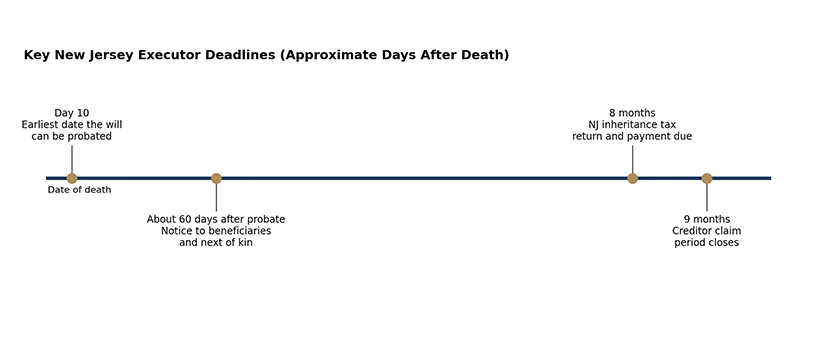
Timeline is approximate. The notice deadline runs from the date of probate, not the date of death.
Step 4: Pay Valid Debts in the Right Order
Creditors generally have nine months from the date of death to present claims against a New Jersey estate. During that period, you review each claim and decide whether it is valid.
If the estate has enough money, it pays valid debts. If it does not, New Jersey law sets a priority order, starting with reasonable funeral expenses and administration costs, followed by debts such as taxes and medical bills from the final illness.
This is where many executors get into trouble. If you distribute money to beneficiaries early and valid debts later surface, you may be personally responsible for paying them.
A safer practice is to hold back enough funds to cover known debts, expenses, and taxes until the creditor period has passed.
Step 5: File Tax Returns and Obtain Tax Waivers
An executor must file several tax returns. Depending on the estate, these may include:
- The deceased person’s final federal and New Jersey income tax returns
- Federal and New Jersey fiduciary income tax returns if the estate earns income during administration
- A New Jersey inheritance tax return, due eight months after death, when property passes to taxable beneficiaries
- A federal estate tax return for estates large enough to require one
New Jersey repealed its estate tax for deaths on or after January 1, 2018, but the inheritance tax still applies. Transfers to a spouse, children, grandchildren, and other Class A beneficiaries are exempt, while transfers to siblings, nieces, nephews, and unrelated people can be taxed.
Banks and brokerages in New Jersey often freeze part of an account until the Division of Taxation issues a tax waiver, even when no tax is owed. Planning for that step keeps distributions from stalling.
Our page on New Jersey inheritance tax and estate tax explains the beneficiary classes and rates in detail.
Step 6: Manage and Sell Property When Needed
While the estate is open, you must manage its property responsibly. That may mean keeping up mortgage and tax payments on a house, maintaining insurance, and deciding whether to hold investments or sell them.
Many Bergen County estates include a family home. If the will gives you a power of sale, you can generally sell real estate without a court order, but the sale must be at a fair price and in the estate’s best interest.
Selling estate property to yourself or a relative at a discount is a classic conflict of interest. If a family member wants to buy the house, get an independent appraisal and consider getting written consent from the other beneficiaries.
Step 7: Keep a Complete Accounting
From the day you are appointed, keep records of every dollar that comes into or leaves the estate. Save receipts, statements, and invoices.
At the end of administration, beneficiaries are entitled to see how the estate was handled. Many New Jersey estates close with an informal accounting that beneficiaries review and approve. When there is disagreement, the executor may need to file a formal accounting with the Superior Court, Chancery Division, Probate Part.
If beneficiaries believe an executor is hiding information or mismanaging assets, the dispute can move into estate litigation. A clear, organized accounting is the best protection against that outcome.
Step 8: Distribute the Estate and Close It Properly
Once debts, expenses, and taxes are paid and the creditor period has passed, you can distribute the remaining assets according to the will.
Before making final distributions, New Jersey executors commonly ask each beneficiary to sign a refunding bond and release. The refunding bond obligates the beneficiary to return their share if needed to pay a debt that surfaces later, and the release confirms they received what they were owed.
These documents are filed with the Surrogate and protect you from future claims. Skipping them is one of the most common and avoidable executor mistakes.
Executor Duties at a Glance
| Phase | Core Executor Tasks | Common Pitfall |
|---|---|---|
| Getting appointed | Locate the original will, obtain death certificates, apply to the Bergen County Surrogate for letters testamentary | Acting on estate accounts before letters are issued |
| Securing assets | Obtain an EIN, open an estate account, inventory and protect property, maintain insurance | Letting a vacant home go uninsured or unmaintained |
| Notice | Mail notice of probate to beneficiaries and next of kin, file proof with the Surrogate | Missing the notice deadline |
| Debts and taxes | Review creditor claims, pay valid debts in statutory order, file final income tax, fiduciary, and inheritance tax returns | Paying beneficiaries before debts and taxes are resolved |
| Accounting | Track every receipt and expense, prepare an accounting for beneficiaries or the court | Commingling estate funds with personal money |
| Distribution | Obtain tax waivers, distribute assets, collect refunding bonds and releases | Distributing without signed releases |
How Executors Are Paid in New Jersey
Executors are entitled to reasonable reimbursement for estate expenses and to a commission set by statute. New Jersey calculates the corpus commission on the estate’s principal at 5 percent of the first $200,000, 3.5 percent of the next $800,000, and 2 percent of the amount above $1,000,000.
Executors may also receive a separate commission on income the estate earns during administration. Many family executors waive their commission, especially when they are also the main beneficiary, because commissions are taxable income while inheritances generally are not.
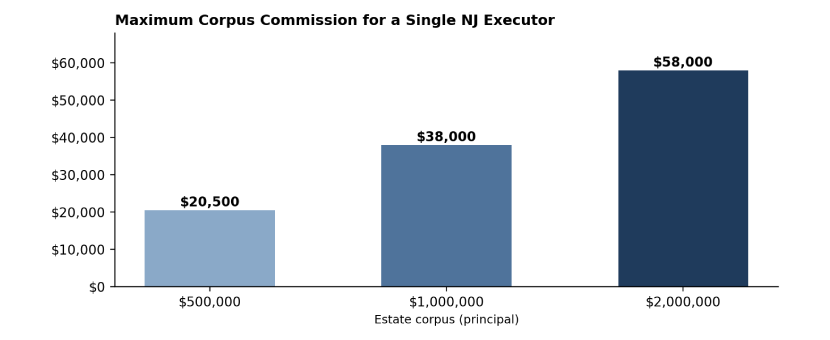
Calculated from N.J.S.A. 3B:18-14 for a single executor. Excludes income commissions and additional executor allowances.
Common Executor Mistakes That Create Liability
- Distributing money to beneficiaries before the creditor period ends and taxes are settled
- Commingling estate funds with personal accounts
- Letting insurance lapse on a vacant home
- Missing the inheritance tax filing deadline and triggering interest
- Selling property to a relative below fair market value
- Failing to keep receipts and records for the accounting
- Closing the estate without refunding bonds and releases
Most of these mistakes come from not knowing the rules rather than bad intentions. The good news is that each one is preventable with early guidance.
When an Executor Should Talk to an Attorney
Some estates are simple enough for a careful executor to handle with limited help. Others benefit from legal guidance from the start, including estates that involve:
- Real estate, especially property in more than one state
- Beneficiaries who are siblings, nieces, nephews, or friends, triggering inheritance tax
- Debts that may exceed the estate’s assets
- A family business or unusual assets
- Family conflict or a possible will contest
- Trusts created under the will
Many families also discover during administration that the will could have been structured to avoid probate entirely. If you are thinking about your own plan after serving as executor, our estate planning page and our guide to a last will and testament are good places to start.
Just named executor of a Bergen County estate?
Attorney Patrick V. Banks has handled estate administration matters throughout Bergen County since 2007. Call 201-483-2338 to schedule your free initial consultation.
Frequently Asked Questions About Executor Duties in New Jersey
What Happens When You Call Patrick Banks Law
When you 201-483-2338, you will be asked to complete a short questionnaire about the estate, whether there is a will, and where things currently stand.
Attorney Banks then reviews your situation with you, whether you have just been named executor or are already partway through administration. Most calls end with a clear next step and a written fee quote, so you know exactly what to expect.
Get Help Serving as Executor in Bergen County
Serving as executor does not have to be overwhelming. With the right guidance, you can meet every deadline, protect yourself from liability, and honor your loved one’s wishes. Patrick Banks Law helps executors in Ridgewood, Upper Saddle River, and throughout Bergen County, and our overview of the New Jersey probate process walks through how each stage fits together.
Call 201-483-2338 or complete our online questionnaire to schedule your free initial consultation.
