


An irrevocable trust generally cannot be changed or revoked once it is signed and funded. In exchange for giving up control, New Jersey families can use irrevocable trusts to reduce estate taxes, protect assets from creditors and long-term care costs, provide for a loved one with special needs, and preserve wealth across generations.
Patrick Banks Law designs irrevocable trusts for families throughout Bergen County.
Most people start estate planning with a will or a revocable living trust. Those tools are flexible, and for many families they are enough.
An irrevocable trust is different. It asks you to make a lasting decision in return for protections a revocable trust cannot provide. If you are still deciding which kind of trust you need, start with our overview of revocable trusts, then use this page to understand when going further makes sense.

The Trade-Off at the Heart of Every Irrevocable Trust
The key idea is simple. The more control you keep over an asset, the more the law treats it as still yours.
With a revocable trust, you keep full control, so the assets remain part of your estate for tax purposes and remain reachable by your creditors. With an irrevocable trust, you give up ownership and most control. That is what allows the assets to be treated as separate from you.
Before creating one, it helps to ask three honest questions:
- Can I live comfortably without direct access to these assets?
- Is the goal I am solving for likely to still matter in 10 or 20 years?
- Do I trust the person I will name as trustee to carry out my wishes?
If the answer to all three is yes, an irrevocable trust may be worth serious consideration.
Irrevocable vs. Revocable Trusts
| Revocable Trust | Irrevocable Trust | |
|---|---|---|
| Can you change it? | Yes, at any time while you are competent | Generally no, except in limited ways the document or New Jersey law allows |
| Who controls the assets? | Usually you, as your own trustee | A trustee other than you, following the trust terms |
| Counted in your taxable estate? | Yes | Often no, if properly structured |
| Protection from your creditors | No | Often yes, depending on the terms |
| Medicaid planning | No benefit | Can help once the look-back period passes |
| Avoids probate? | Yes, for funded assets | Yes, for funded assets |
Six Reasons New Jersey Families Choose Irrevocable Trusts
1. Reducing Federal Estate Tax
New Jersey no longer has an estate tax for deaths on or after January 1, 2018. The federal estate tax still applies to larger estates.
For 2026, the federal estate and gift tax exemption is $15 million per person, following the 2025 federal tax law that raised and extended it. Married couples can effectively shelter twice that amount with proper planning.

Source: IRS inflation adjustments and federal tax legislation. Figures are per individual.
Families near or above that level often use irrevocable trusts, such as spousal lifetime access trusts and irrevocable life insurance trusts, to move future growth out of the taxable estate.
2. Planning for New Jersey Inheritance Tax
New Jersey’s inheritance tax still applies to transfers to certain beneficiaries, such as siblings, nieces, nephews, and friends. Transfers to a spouse, children, and grandchildren are exempt.
Timing matters here. Transfers made within three years of death to taxable beneficiaries can be pulled back into the inheritance tax calculation. Our page on New Jersey inheritance tax and estate tax explains the beneficiary classes and rates.
Planning early, rather than making large gifts late in life, is often the most effective strategy.
3. Protecting Assets From Long-Term Care Costs
Nursing home care in New Jersey can cost tens of thousands of dollars per month and quickly drain a lifetime of savings. A Medicaid asset protection trust is designed to shelter assets so Medicaid doesn’t count them toward eligibility.
The catch is timing. New Jersey Medicaid reviews transfers made during the 60 months before an application. Assets moved into an irrevocable trust within that window can trigger a penalty period.
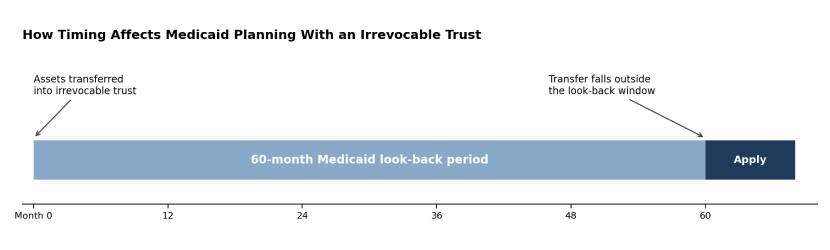
That is why this kind of planning works best while you are healthy, long before you need care.
4. Providing for a Loved One With Special Needs
Leaving money directly to a person with a disability can disqualify them from means-tested benefits such as Supplemental Security Income and Medicaid. A supplemental needs trust holds the money instead.
The trustee can pay for quality-of-life improvements, such as therapies, education, travel, and equipment, without replacing the public benefits the person relies on.
5. Building a Multigenerational Legacy
New Jersey is one of the states that allows trusts to last indefinitely, making it possible to create a dynasty trust that benefits children, grandchildren, and future generations.
A dynasty trust can keep family wealth professionally managed, protect it from beneficiaries’ creditors and divorces, and align it with the family’s values. An education trust is a more focused version, reserving funds specifically for tuition and related costs.
6. Keeping Life Insurance Out of Your Estate
Life insurance proceeds are often counted in the insured person’s taxable estate. An irrevocable life insurance trust owns the policy instead, so the proceeds can pass outside the estate.
The trust also controls how the money is used. That can matter a great deal when beneficiaries are young, when a business buy-sell agreement depends on the policy, or when a blended family needs a clear plan.
Common Types of Irrevocable Trusts
| Type of Irrevocable Trust | Main Purpose | Often a Fit For |
|---|---|---|
| Irrevocable life insurance trust (ILIT) | Keeps life insurance proceeds out of the taxable estate and controls how they are used | Families with large policies or business owners funding a buy-sell plan |
| Medicaid asset protection trust | Protects assets from long-term care costs after the look-back period | Older adults planning ahead for possible nursing home care |
| Supplemental needs trust | Provides for a person with a disability without disrupting public benefits | Parents of a child with special needs |
| Dynasty trust | Holds wealth for multiple generations with ongoing management | Families planning well beyond their children’s lifetimes |
| Education trust | Sets aside funds specifically for tuition and education costs | Grandparents and parents funding school for younger generations |
| Spousal lifetime access trust (SLAT) | Removes assets from the estate while allowing indirect spousal access | Married couples with estates near the federal exemption |
| Charitable remainder trust | Provides income to you, then passes the remainder to charity | Donors with appreciated assets who want income and a legacy |
What Giving Up Control Really Means
Irrevocable does not always mean frozen forever. It does mean you cannot simply change your mind.
Once the trust is funded, the trustee manages the assets according to the trust document. You generally cannot take the assets back, move them into your own name, or rewrite the beneficiaries.
Modern trusts can still build in some flexibility. Depending on the goals, a trust may include:
- A trust protector who can make limited adjustments if laws or circumstances change
- Powers of appointment that let a beneficiary redirect assets in their own estate plan
- Provisions allowing a trustee to be replaced
- Discretionary distribution standards that adapt to each beneficiary’s needs
New Jersey’s trust code also allows modification or termination in some situations, such as with the agreement of the settlor and all beneficiaries, or with court approval when circumstances have changed in ways no one anticipated.
How Irrevocable Trusts Are Taxed
Tax treatment depends on how the trust is drafted. Two broad categories matter most.
Grantor trusts. The person who created the trust continues to pay income tax on the trust’s earnings. This can be a planning advantage, because paying the tax effectively lets more wealth grow inside the trust for beneficiaries.
Non-grantor trusts. The trust is its own taxpayer and files its own returns. Trust income tax brackets are compressed, reaching the top federal rate at a much lower income level than individual brackets.
Gifts into an irrevocable trust may also use part of your federal gift tax exemption or annual exclusion. New Jersey does not have a separate gift tax, but its inheritance tax rules on transfers made shortly before death still apply.
Funding the Trust Correctly
An irrevocable trust only protects assets that are actually transferred into it. Signing the document is only half the job.
Funding might involve retitling a brokerage account, recording a deed for real estate, changing the owner and beneficiary of a life insurance policy, or assigning business interests. Each asset has its own steps, and mistakes can undo the benefits the trust was designed to provide.
Retirement accounts deserve special care. They usually cannot be moved into a trust during your lifetime without triggering tax, although a trust can sometimes be named as a beneficiary.
Choosing the Right Trustee
Because an irrevocable trust can last for decades, the trustee choice may be the single most important decision you make.
A good trustee is organized, impartial, and willing to follow the trust terms even when a beneficiary is unhappy. Many families name a trusted relative alongside a professional co-trustee, or name successor trustees who can step in over time.
When trustees and beneficiaries clash, the dispute can end up in court. Our page on trust litigation and disputes explains how those conflicts arise, and our guide to trust administration explains what trustees are expected to do.


Is an Irrevocable Trust Right for You?
An irrevocable trust may be worth exploring if you:
- Have an estate approaching the federal exemption amount
- Want to protect savings or a home from future long-term care costs
- Have a child or grandchild with special needs
- Own a large life insurance policy or a family business
- Want to fund education or preserve wealth for future generations
- Are in a blended family and want certainty about who ultimately inherits
It may not be the right fit if you expect to need the assets yourself or want the freedom to change your plan often. In that case, a revocable trust paired with a well-drafted last will and testament may serve you better.
Wondering whether an irrevocable trust fits your goals? Attorney Patrick V. Banks has helped Bergen County families plan for the future since 2007, including dynasty trusts, education trusts, and blended family planning. Call 201-483-2338 to schedule your free initial consultation.
Frequently Asked Questions About Irrevocable Trusts in New Jersey
Starting the Conversation With Patrick Banks Law
Your first step is a short questionnaire about your family, your assets, and what you want your plan to accomplish. That gives Attorney Banks a clear picture before you speak.
During your call, he will talk through whether an irrevocable trust makes sense, which type fits your goals, and what the trade-offs look like for your family. You will receive a written fee quote before any work begins.
Plan With Confidence in Bergen County
An irrevocable trust is a long-term commitment, and it deserves careful design. Patrick Banks Law helps families in Ridgewood, Upper Saddle River, and throughout Bergen County build plans that protect what matters most. Learn more about our full approach to Bergen County estate planning.
Call 201-483-2338 or complete our online questionnaire to schedule your free initial consultation.
