


Patrick Banks Law drafts and funds revocable living trusts for individuals and families throughout Bergen County, New Jersey. Attorney Patrick Banks structures trusts that avoid probate, keep asset distribution private, and give a successor trustee immediate authority to manage your affairs if you become incapacitated. A revocable trust is one of the more flexible planning tools available, and a free initial call is the place to start.
A revocable living trust is often described as a will substitute, but that undersells what it actually does.
It manages your assets while you are alive, steps in seamlessly if you become incapacitated, and distributes what remains after you pass away, all without a Bergen County Surrogate’s Court filing for anything properly transferred into it.
Attorney Banks has drafted and funded revocable trusts for Bergen County families since 2007, and has also handled trust administration and trust litigation, which shapes how carefully he approaches the funding step most other firms treat as an afterthought.
Seeing what happens on the administration and litigation side of an improperly funded trust is exactly what makes that difference in approach. A trust that looks complete on paper but was never actually funded creates the same probate problems it was meant to avoid, and families rarely discover this until it is too late to fix easily.
How a Revocable Living Trust Works
A revocable trust is a legal arrangement you create during your lifetime, naming yourself as both the person who funds it (the grantor) and the trustee who manages it.
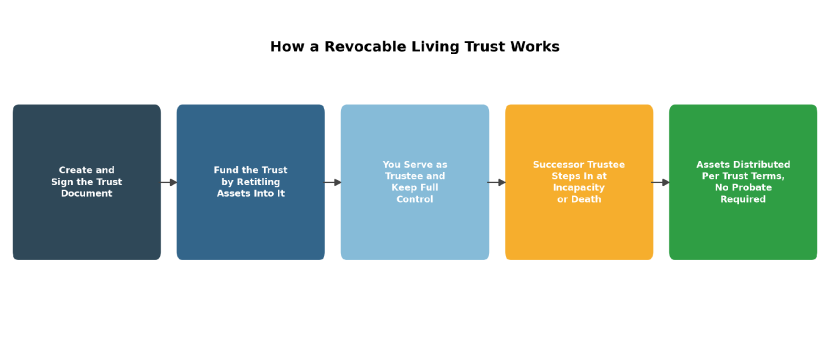
General life cycle of a properly funded revocable living trust.
You retain complete control over trust assets while you are alive and competent. You can add or remove assets, change beneficiaries, or revoke the entire trust at any time, which is what makes it revocable.
You typically also name a successor trustee, someone who steps in to manage the trust if you become incapacitated or after you pass away, without needing a court’s permission to act.
Because you serve as your own trustee while alive and competent, day-to-day life with a funded trust looks almost identical to life without one. You still write checks, manage investments, and use your accounts exactly as before, just under the trust’s ownership rather than your own name directly.
This continuity is often what surprises new clients most. A trust changes who legally owns an asset on paper, not how you actually live your life or manage your money day to day.
Who Should Consider a Revocable Trust
A revocable trust often makes the most sense for homeowners, particularly in a high-value market like Bergen County, since real estate is often the single asset that benefits most from avoiding probate.
It also fits families who own property in more than one state, since a will alone would otherwise require a separate ancillary probate proceeding in each state where real estate is titled in your own name.
Business owners with a closely held company also benefit, since a properly funded trust can hold business interests and allow a successor trustee to step in and keep the business stable during incapacity, without first waiting on a guardianship proceeding.
Anyone who values privacy over the relative simplicity of a will alone, or who wants a clear incapacity plan beyond a power of attorney, is also a good candidate for this structure.
Why Funding the Trust Is the Step That Actually Matters
Signing a trust document does very little on its own. A trust controls only the assets that have been retitled into its name.
Funding means changing the ownership of your home, bank accounts, investment accounts, and other property so the trust, not you personally, holds legal title. A deed has to be recorded. You must update account paperwork with each bank and brokerage.
This is the step families most often skip or do halfway, usually because it feels like paperwork rather than legal work. Attorney Banks treats funding as part of the engagement itself, not a homework assignment left for the client to finish alone, because an unfunded trust protects nothing.
Any asset left titled in your own name at your death still passes through probate regardless of what your trust document says, which defeats the purpose of creating the trust in the first place.
What Typically Gets Retitled
Real estate is retitled through a new deed, prepared and recorded with the county, transferring ownership from you individually to you as trustee of the trust.
Bank and brokerage accounts are typically retitled directly with each institution, which usually means new account paperwork rather than opening an entirely new account.
Retirement accounts, including IRAs and 401(k) plans, are generally not retitled into the trust, since doing so can trigger unintended tax consequences. Instead, the trust is often named as a contingent beneficiary, with a primary beneficiary designation handled separately.
Vehicles and other personal property can also be assigned to the trust through a general assignment document, a simpler step than a formal title transfer, though New Jersey title transfer rules for vehicles specifically are worth confirming with your attorney.

What Happens if You Become Incapacitated
One of the most practical benefits of a funded revocable trust shows up before death, not after.
If you become unable to manage your own affairs, your named successor trustee can step in immediately to pay bills, manage investments, and handle property held in the trust, without petitioning the Superior Court for guardianship.
A guardianship proceeding is public, requires medical evaluations, and places your finances under ongoing court supervision. A properly funded trust avoids all of that for any asset it holds, which is why Attorney Banks generally pairs a revocable trust with a durable power of attorney rather than relying on either document alone.
The power of attorney covers assets outside the trust and other financial matters a trust does not reach, while the trust covers everything actually retitled into it, giving your successor trustee and agent overlapping but complementary authority when you cannot act for yourself.
Privacy and Avoiding Probate
A will becomes a public record once you file it with the Bergen County Surrogate’s Court. Anyone can request a copy and see exactly what you owned and who inherited it.
A revocable trust generally isn’t filed with any court and doesn’t become public record. For Bergen County families who value privacy, particularly those with significant real estate holdings in towns such as Ridgewood or Upper Saddle River, this is often reason enough to choose a trust-based plan.
Avoiding probate also means avoiding the time and cost of Surrogate’s Court administration for trust assets. Beneficiaries can generally receive their inheritance faster through a well-administered trust than through a fully probated estate.
This speed advantage matters most when a beneficiary needs access to funds relatively quickly, such as a surviving spouse who relies on trust assets for ongoing living expenses rather than waiting out a lengthy probate timeline.
What a Revocable Trust Does Not Do
A revocable trust does not protect your assets from your own creditors or lawsuits while you are alive. Because you retain full control and can revoke the trust at any time, the law treats trust assets as though they were still yours for these purposes.
A revocable trust also does not reduce your New Jersey inheritance tax exposure. Assets in the trust are still counted as part of your estate for inheritance tax purposes and taxed the same way they would be if you had never created the trust.
Families looking for creditor protection or a way to reduce a beneficiary’s inheritance tax exposure generally need an irrevocable trust structure instead, which involves giving up the control a revocable trust lets you keep.
This tradeoff is worth understanding clearly before choosing a structure, since some families come to a revocable trust expecting creditor protection it was never designed to provide, only to find that expectation unmet if a lawsuit or judgment arises later.
Revocable Trust Compared to Irrevocable Trust
The two trust types solve different problems, and understanding the tradeoff helps clarify which one, or which combination, actually fits your goals.
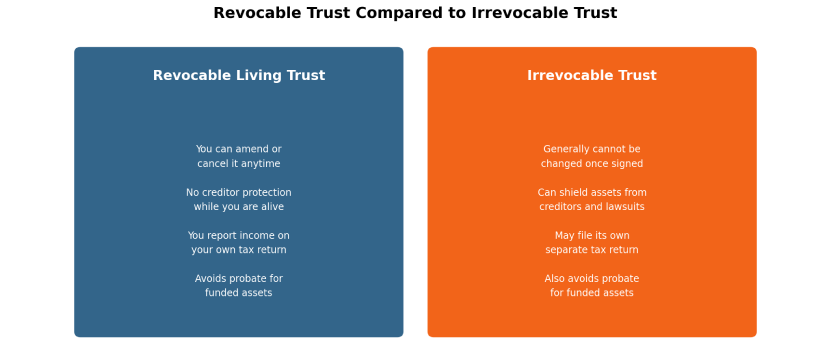
A general comparison. Specific tax and legal treatment can vary by circumstance.
A revocable trust prioritizes flexibility and control. An irrevocable trust prioritizes protection, whether from creditors, lawsuits, or future inheritance tax exposure, in exchange for giving up the ability to easily change your mind later.
Many complete Bergen County estate plans use both. A revocable trust holds the family home and everyday accounts, while an irrevocable dynasty or education trust protects a separate portion of assets intended for future generations.
Deciding how to split assets between the two structures depends on your goals, your comfort with giving up control over a portion of your estate, and how much of your plan focuses on your lifetime needs versus what you leave behind.
Attorney Banks walks through this tradeoff with each client rather than defaulting to one structure, since the right answer depends heavily on your family situation and long-term goals, not a one-size-fits-all recommendation.
A Revocable Trust Still Needs a Will
Even a well-funded trust benefits from a companion document called a pour-over will.
A pour-over will directs any asset accidentally left outside the trust, whether from an oversight or a late-acquired asset never retitled, into the trust after your death. It acts as a safety net rather than a primary distribution tool.
A pour-over will still have to go through probate for whatever assets it catches, but a well-funded trust generally leaves very little for it to actually catch.
Some families also keep a small, jointly held checking account outside the trust specifically to cover immediate expenses after death, before the trust’s assets become fully accessible to the successor trustee, without relying on the pour-over will to move that money.


Common Funding Mistakes
A new bank account opened after the trust was signed but never retitled into the trust’s name is one of the most common gaps families discover only after it is too late to fix easily.
Refinancing a home can also accidentally remove it from the trust if the new deed is not prepared correctly, since some lenders require the property to be temporarily deeded back to the individual borrower during the refinance process.
Failing to deed the property back into the trust after the refinance closes is one of the single most common gaps Attorney Banks finds when reviewing an existing trust for a new client.
A trust amended years after the original signing to add a new asset sometimes has the updated schedule of assets attached incorrectly, leaving ambiguity about what the trust actually holds. Periodic review catches these gaps before they become a problem for your successor trustee to untangle.
Attorney Banks recommends a funding review every few years, and always after a major purchase or refinance, since these are the exact moments a newly acquired or refinanced asset is most likely to slip through without being properly retitled.
Frequently Asked Questions
Common Concerns About Setting Up a Trust
“A trust sounds like it is only for wealthy families.”
Privacy, incapacity planning, and probate avoidance benefit families at a wide range of asset levels, not only large estates.
“I already have a will, so I do not need a trust too.”
A will and a trust solve different problems. A trust avoids probate and provides for incapacity; a will alone does neither.
“Funding the trust sounds like a hassle.”
It takes real effort, which is exactly why an unfunded trust is one of the most common estate planning mistakes. Handling the funding process as part of the engagement keeps it from being left half-finished.
What Happens When You Call
Reaching out starts with a free initial phone call or meeting.
Before that call, you complete a short questionnaire covering your assets, your family, and your goals. During the call, Attorney Banks reviews whether a revocable trust fits your situation and explains what funding it will actually involve. Most calls end with a clear plan and an exact fee quote in writing.
Set Up Your Revocable Trust Correctly
A trust that is never fully funded protects nothing, no matter how well the document is written.
Call Patrick Banks Law at 201-483-2338 to schedule your free initial consultation.
